

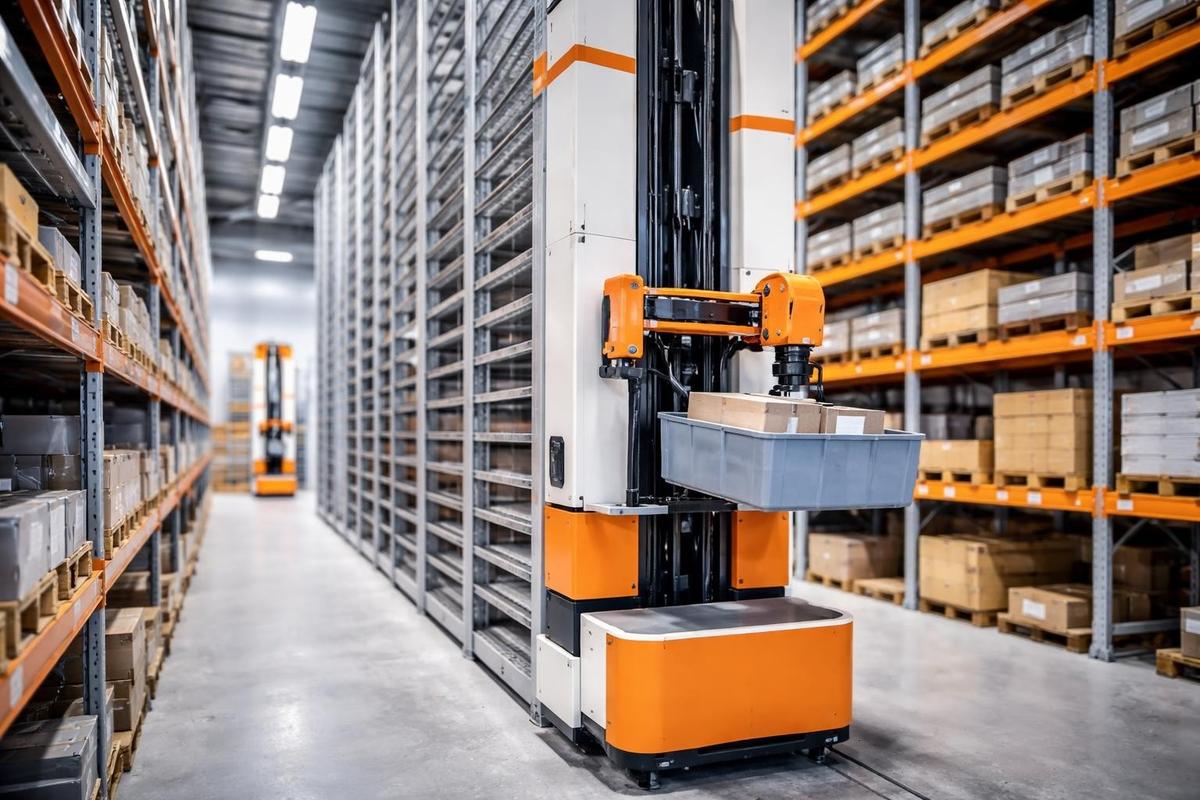
ASRS Storage: Transform Warehouse Efficiency in 2026
Share on
Modern warehouses face relentless pressure to process higher volumes with limited floor space while controlling labour costs and maintaining accuracy. Automated storage and retrieval systems (ASRS) have emerged as a transformative solution for logistics operations seeking competitive advantage through automation. As supply chain complexity increases and customer expectations for rapid fulfilment intensify, asrs storage technology delivers measurable improvements in density, throughput, and operational efficiency across diverse warehouse environments.
Understanding ASRS Storage Technology
Automated storage and retrieval systems represent computer-controlled methods for automatically placing and retrieving items from designated storage locations. These systems eliminate manual handling for storage and retrieval operations, using sophisticated software to coordinate robotics, conveyors, and material handling equipment.
ASRS storage encompasses multiple technology variants, each suited to different operational requirements. Unit-load systems handle full pallets, whilst mini-load configurations manage totes and cartons. Vertical lift modules maximise ceiling height, and horizontal carousels bring items to operators. The common thread across all implementations is eliminating wasted motion and optimising storage density through precision automation.
Core Components of Modern Systems
Every asrs storage implementation combines hardware and software working in synchronised coordination:
- Storage structure: Racking or shelving configured for automated access
- Storage and retrieval machines: Robotics or mechanical systems that move inventory
- Conveyor systems: Transport mechanisms connecting ASRS to workflow zones
- Warehouse management software: Intelligence layer coordinating inventory placement and retrieval
- Control systems: Real-time coordination of mechanical components and safety protocols
The integration quality between these components directly impacts system performance and reliability. Modern implementations leverage advanced sensors, machine learning algorithms, and predictive maintenance capabilities to optimise operations continuously.

Quantifiable Benefits Driving Adoption
Organisations implementing asrs storage systems report substantial operational improvements across multiple performance dimensions. The benefits of ASRS extend beyond simple automation, fundamentally transforming warehouse economics and capabilities.
Space Utilisation and Density Gains
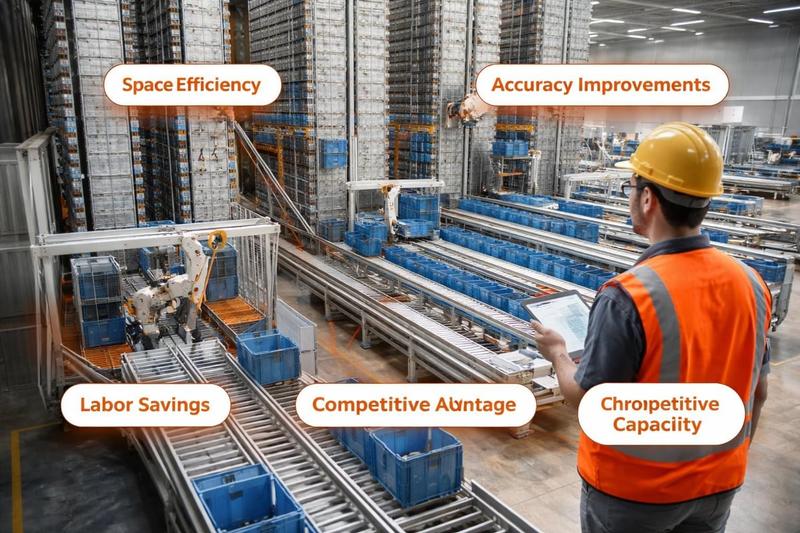
Traditional manual warehouses waste significant cubic capacity through wide aisles, inefficient layout, and conservative vertical utilisation. ASRS storage maximises three-dimensional space usage through narrow aisles, high-density racking reaching 15 metres or higher, and precise placement algorithms.
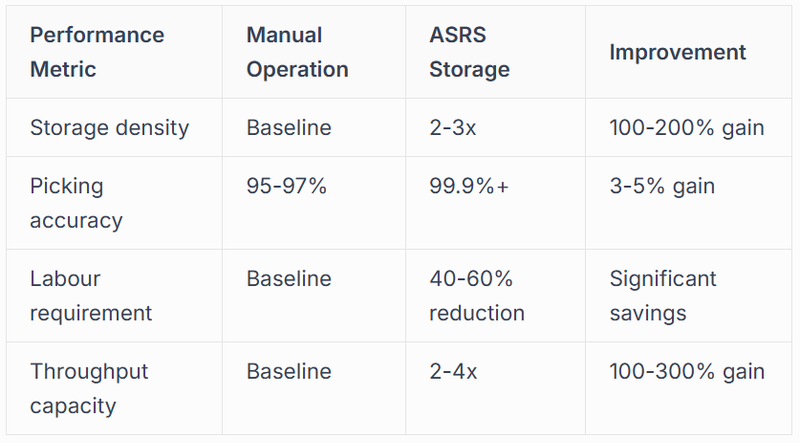
Typical implementations achieve 40-50% space reclamation compared to manual operations. This density improvement either reduces facility footprint requirements or enables substantial inventory expansion within existing buildings. For organisations facing expensive real estate markets, the cost reduction potential becomes particularly compelling.
Labour Optimisation and Productivity
Asrs storage systems dramatically reduce walking and searching time that consumes productive hours in manual warehouses. Instead of operators travelling to inventory locations, automated systems deliver items to ergonomic picking stations.
This goods-to-person approach transforms labour economics. Fewer personnel handle greater volumes whilst experiencing reduced physical strain and fatigue. Organisations report 50-70% labour requirement reductions whilst simultaneously improving throughput capacity. The productivity gains compound over time as systems learn optimal storage strategies and operators become proficient with automated workflows.
Accuracy and Quality Improvements
Human error represents a persistent challenge in manual warehouse operations. Picking mistakes, inventory discrepancies, and misplaced items create costly corrections and customer dissatisfaction. ASRS storage virtually eliminates these issues through systematic tracking and verification.
Barcode scanning, weight verification, and photographic confirmation ensure correct item selection. Inventory locations maintain precision through computerised tracking rather than relying on operator memory or paper documentation. End-user experiences shared through warehouse automation forums consistently highlight accuracy improvements as a transformative benefit.
Industry-Specific Applications
Different sectors leverage asrs storage capabilities to address unique operational challenges and regulatory requirements. Understanding industry-specific considerations helps organisations design implementations matching their precise needs.
Food and Beverage Operations
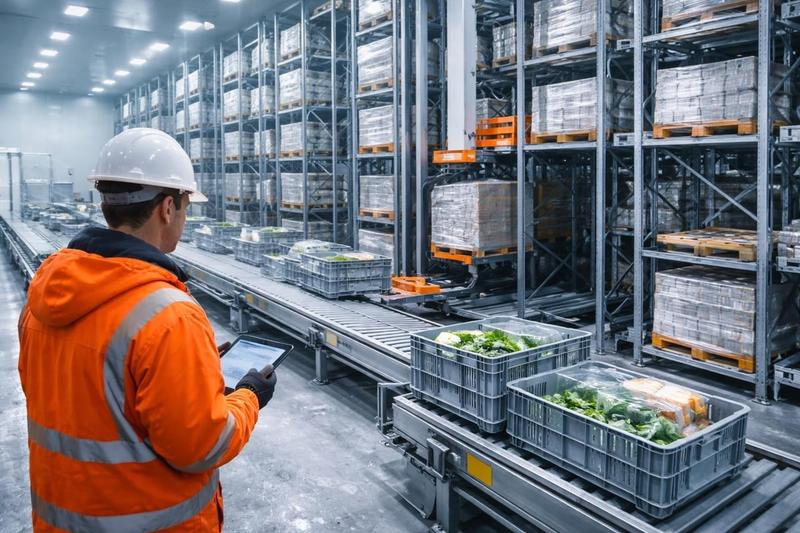
Temperature-controlled environments present particular challenges for manual labour whilst demanding strict rotation protocols. Asrs storage systems operate reliably in refrigerated and frozen conditions where human productivity suffers. Automated systems enforce first-in-first-out rotation automatically, maintaining product freshness and regulatory compliance.
Beverage industry implementations demonstrate how ASRS addresses space constraints whilst managing diverse SKU profiles from raw materials through finished goods. The ability to maintain precise environmental conditions whilst maximising storage density creates compelling value for perishable goods handlers.
Pharmaceutical and Healthcare Logistics
Pharmaceutical operations require absolute inventory accuracy, traceability, and secure storage. ASRS storage provides the controlled environment and systematic tracking essential for regulated products. Batch tracking, expiry management, and controlled substance security integrate seamlessly into automated workflows.
The precision and documentation capabilities of asrs storage systems align perfectly with pharmaceutical quality standards and regulatory expectations. Automated environmental monitoring ensures proper storage conditions whilst detailed transaction logs support compliance auditing and recall management.
E-commerce and Third-Party Logistics
High-velocity fulfilment operations demand exceptional throughput and accuracy under tight time constraints. ASRS storage enables 3PL providers and e-commerce operators to handle peak volumes without proportional labour scaling. The buffer capacity and processing speed support same-day and next-day delivery commitments whilst maintaining quality standards.
Multi-client 3PL operations particularly benefit from the inventory segregation and tracking capabilities automated systems provide. Different customer inventories coexist within unified infrastructure whilst maintaining complete visibility and control.
Implementation Considerations and Planning
Successful asrs storage deployment requires thorough analysis and strategic planning. Organisations must evaluate readiness factors, design appropriate configurations, and manage change systematically.
Operational Analysis and Specification
Implementation begins with comprehensive operational assessment:
- Inventory profiling: Analyse SKU velocity, dimensions, weights, and handling requirements
- Volume forecasting: Project throughput requirements across seasonal patterns and growth trajectories
- Workflow mapping: Document current processes and identify automation opportunities
- Space evaluation: Assess building dimensions, floor loading, and infrastructure capacity
- Integration requirements: Identify connections to existing systems and processes
This analysis informs system specification, ensuring the selected asrs storage configuration matches operational realities rather than theoretical capabilities. Oversizing creates unnecessary capital expenditure whilst undersizing constrains future capacity.
Technology Selection and Configuration
Multiple asrs storage variants suit different operational profiles. Unit-load systems excel in pallet-handling environments with moderate SKU counts. Mini-load configurations optimise piece-picking operations with extensive SKU variety. Shuttle systems provide exceptional throughput for fast-moving inventory, whilst vertical lift modules maximise space efficiency in compact facilities.
For businesses beginning their automation journey, solutions like the Automate-X GTP Starter Grid provide accessible entry points that deliver measurable benefits whilst building organisational capabilities for future expansion. Starting with focused automation in high-impact areas creates proof of concept and operational experience before enterprise-wide deployment.
Risk Mitigation and Change Management
Deploying asrs storage introduces operational dependencies requiring careful risk management. Power redundancy, maintenance protocols, and contingency procedures ensure business continuity. Fire safety considerations demand particular attention in high-density automated environments where conventional suppression approaches may prove inadequate.
Workforce transition represents another critical success factor. Training programmes, communication strategies, and role redesign help personnel adapt to automated workflows. Rather than replacing workers, successful implementations redeploy human talent to higher-value activities requiring judgement and problem-solving.
Overcoming Common Implementation Challenges
Even well-planned asrs storage projects encounter obstacles during deployment and operation. Anticipating these challenges and preparing mitigation strategies accelerates value realisation and reduces disruption.
Integration Complexity
Modern warehouses operate multiple software systems managing inventory, orders, transport, and finances. ASRS storage must integrate seamlessly with existing infrastructure, sharing data and coordinating workflows. Common integration challenges include data format mismatches, communication protocol incompatibilities, and timing coordination issues.
Addressing these obstacles requires experienced system integrators who understand both warehouse operations and technical architecture. Robust testing protocols verify functionality before go-live, whilst staged deployment approaches limit exposure during transition periods.
Operational Flexibility Requirements
Warehouse operations evolve continuously through new products, changing order profiles, and seasonal patterns. ASRS storage configurations must accommodate variability rather than assuming static conditions. Modular designs, configurable parameters, and adaptive algorithms provide the flexibility modern operations demand.
Leading implementations incorporate learning capabilities that optimise storage strategies based on actual transaction patterns. This continuous improvement ensures sustained performance as operational characteristics shift over time.
Maintenance and Reliability Management
Automated systems require systematic maintenance to sustain performance and availability. Predictive maintenance programmes monitor component health, identifying potential failures before operational impact. Spare parts inventory, technician training, and vendor support agreements ensure rapid response when issues arise.
Organizations implementing asrs storage must balance automation benefits against operational dependencies. Designing appropriate redundancy, maintaining manual fallback capabilities for critical processes, and developing skilled internal teams creates resilience against system disruptions.
Technology Trends Shaping Future Development
The asrs storage landscape continues evolving through technological advancement and changing operational requirements. Understanding emerging trends helps organisations make future-ready investment decisions.
Artificial Intelligence and Machine Learning
Modern asrs storage systems increasingly incorporate AI capabilities that optimise performance through experience. Machine learning algorithms analyse transaction patterns, predicting demand and positioning inventory for efficient retrieval. These intelligent systems reduce energy consumption, balance component wear, and adapt to changing operational patterns automatically.
The combination of industrial robotics capabilities with AI-driven decision-making creates systems that improve continuously without manual intervention. This autonomous optimisation delivers sustained competitive advantage as operational efficiency compounds over time.
Scalable and Modular Architectures
Traditional asrs storage implementations required substantial upfront investment and lengthy deployment timelines. Modern approaches emphasise modularity and scalability, allowing organisations to start focused and expand systematically. Grid-based systems and distributed architectures enable incremental capacity addition matching business growth.
This approach reduces financial risk whilst building operational expertise progressively. Organisations learn through initial deployments, refining processes before broader rollout. The recent warehouse automation projects across New Zealand demonstrate this staged deployment philosophy delivering measurable results.
Sustainability and Energy Efficiency
Environmental considerations increasingly influence warehouse automation decisions. ASRS storage contributes to sustainability objectives through multiple mechanisms. Reduced building footprints lower construction materials and land consumption. Optimised travel paths and regenerative braking reduce energy requirements. Precise climate control in compact footprints minimises heating and cooling loads.
Organizations pursuing carbon reduction targets find asrs storage implementations align with broader environmental commitments whilst delivering operational benefits. This dual value proposition strengthens business cases and stakeholder support.
Financial Analysis and Return on Investment
Asrs storage represents substantial capital investment requiring rigorous financial justification. Comprehensive analysis considers multiple value dimensions beyond simple cost displacement.
Cost Components and Investment Structure
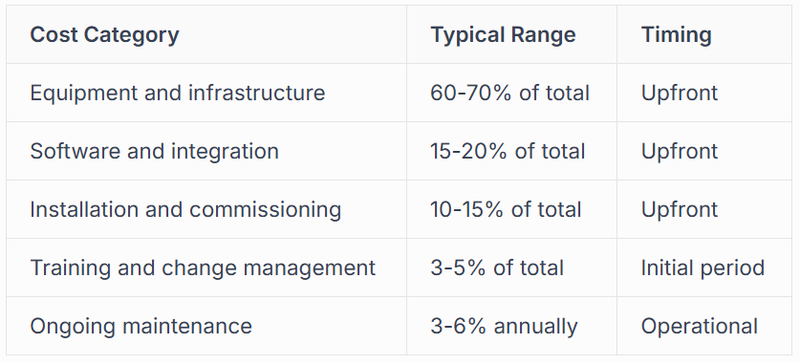
Understanding cost structure helps organisations plan financing approaches and cash flow requirements. Vendor financing, operating leases, and phased deployment models provide alternatives to full upfront capital expenditure.
Value Realisation Timeline
ASRS storage benefits materialise across different timeframes. Labour savings appear immediately upon go-live, whilst space reclamation value depends on lease renewal timing or expansion deferrals. Accuracy improvements reduce returns processing and customer service costs progressively. Throughput capacity enables revenue growth that manual operations couldn't support.
Comprehensive ROI analysis incorporates these diverse value streams across appropriate time horizons. Most implementations achieve payback within 3-5 years, though specific results depend on operational characteristics and alternative scenarios.
Strategic Value Beyond Financial Returns
Some asrs storage benefits resist precise quantification yet create substantial competitive advantage. Enhanced customer service through faster, more accurate fulfilment strengthens market position. Improved workplace safety and ergonomics support recruitment and retention in tight labour markets. Environmental performance addresses stakeholder expectations and regulatory trends.
Strategic value considerations often prove decisive when financial analysis alone shows marginal returns. The organisations navigating implementation challenges successfully typically maintain clear vision of both quantitative and qualitative objectives.
Selecting Implementation Partners
Technology selection represents only part of successful asrs storage deployment. Partner capabilities in design, integration, commissioning, and ongoing support substantially impact outcomes.
Evaluation Criteria for System Providers
Organisations should assess potential partners across multiple dimensions:
- Industry experience: Relevant sector knowledge and reference installations
- Technical capabilities: Engineering expertise and integration proficiency
- Geographic presence: Local support availability and response capabilities
- Financial stability: Long-term viability for ongoing partnership
- Innovation commitment: Continuous improvement and technology advancement
Thorough partner evaluation reduces implementation risk and ensures access to expertise throughout the system lifecycle.
Collaborative Design and Deployment
The most successful asrs storage implementations emerge from collaborative partnerships rather than vendor-customer transactions. Joint design workshops, operational simulations, and iterative refinement create solutions matching actual needs rather than standard configurations.
Effective partners challenge assumptions, propose alternatives, and share lessons from comparable deployments. This consultative approach accelerates learning and improves outcomes for organisations new to warehouse automation.
ASRS storage technology delivers transformative benefits across diverse warehouse operations, from compact goods-to-person systems to enterprise-scale automated facilities. The operational improvements, cost reductions, and competitive advantages make automation increasingly essential for logistics operations pursuing sustainable growth. If you're ready to explore how intelligent automation can transform your warehouse performance, Automate-X combines proven robotics, sophisticated software, and deep integration expertise to design solutions matching your precise operational requirements and growth objectives.