

Automated Pallet Storage: Transform Your Warehouse
Share on
Modern warehouses face relentless pressure to maximise storage density, accelerate throughput, and reduce operational costs while maintaining accuracy. Traditional manual pallet handling simply cannot keep pace with the demands of contemporary supply chains, particularly in sectors like e-commerce, pharmaceuticals, and FMCG where precision and speed define competitive advantage. Automated pallet storage represents a fundamental shift in how businesses approach warehouse operations, combining robotics, intelligent software, and advanced racking systems to create storage environments that operate with unprecedented efficiency and reliability. For logistics providers, 3PLs, and distribution centres across Australia and New Zealand, understanding the capabilities and implementation pathways of these systems has become essential to remaining competitive in an increasingly automated landscape.
Understanding Automated Pallet Storage Systems
Automated pallet storage encompasses a range of technologies designed to store, retrieve, and manage palletised goods without direct human intervention. At its core, these systems use mechanical equipment guided by sophisticated warehouse management software to move pallets between storage locations and picking stations.
The fundamental components include storage structures, material handling equipment, control systems, and integration software. Storage structures typically consist of high-density racking configured to maximise vertical space utilisation. Material handling equipment varies from stacker cranes and shuttle systems to autonomous mobile robots (AMRs) and automated guided vehicles (AGVs). Control systems coordinate all movements, manage inventory positions, and optimise storage algorithms.
These systems differ fundamentally from conventional storage approaches. Where traditional warehouses rely on forklift operators to navigate aisles and manually place pallets, automated solutions use predetermined pathways and precise positioning mechanisms. This eliminates the need for wide operating aisles, significantly increasing storage density.
Primary Technology Categories
Several distinct technology approaches dominate the automated pallet storage landscape, each offering specific advantages for different operational requirements.
Automated Storage and Retrieval Systems (AS/RS) represent the most established category. These systems use stacker cranes travelling on rails within narrow aisles to place and retrieve pallets from multi-level racking. Buffalo Trace Distillery's implementation of high-density automated storage and retrieval systems demonstrates how AS/RS technology modernises distribution operations whilst maximising space efficiency.
Pallet shuttle systems provide an alternative approach, using motorised shuttles that travel horizontally within racking channels. These shuttles can service multiple deep storage positions, creating high-density storage without requiring dedicated cranes for each aisle. A leading drinks manufacturer's shuttle racking implementation showcases the technology's capacity to enhance both storage density and operational flexibility.
Mobile racking systems with automated controls offer yet another solution, particularly suited to environments requiring very high storage density but lower throughput rates. These systems move entire racking structures to create access aisles only when needed.
Operational Benefits and Performance Metrics
The transformation automated pallet storage delivers extends across multiple operational dimensions, creating measurable improvements that directly impact profitability and competitive positioning.
Space utilisation improvements typically range from 40% to 85% compared to conventional forklift operations. By eliminating wide operating aisles and maximising vertical height, automated systems dramatically increase storage capacity within existing footprints. Pepsi Bottling Ventures achieved a 61.5% storage capacity increase through automated pallet shuttle technology, demonstrating the substantial space gains possible.
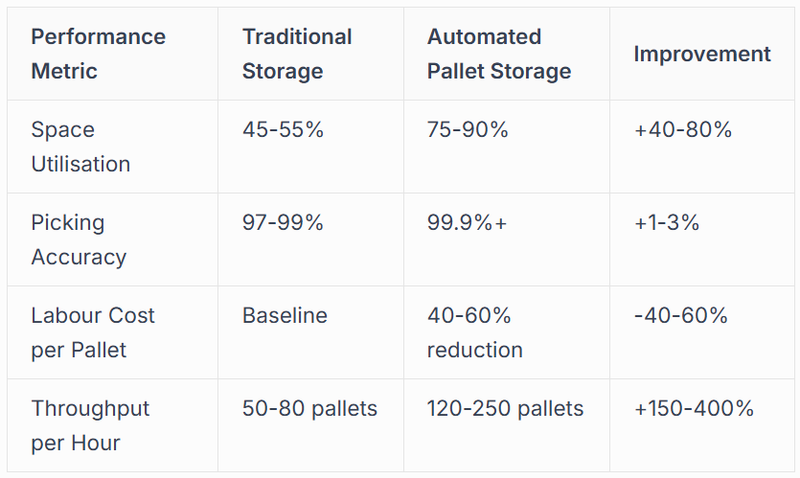
Labour productivity gains represent another critical advantage. Automated systems eliminate repetitive travel and search time, allowing personnel to focus on value-adding activities rather than pallet movement. This redeployment of human resources creates opportunities for quality control, exception handling, and process optimisation.
Inventory accuracy improves substantially when automation removes human error from the storage equation. Real-time tracking through integrated software systems ensures precise location data, whilst automated movements eliminate misplacements. For pharmaceutical and food & beverage operations where traceability requirements are stringent, this accuracy proves invaluable.
Safety enhancements constitute an often-underestimated benefit. Removing personnel from high-traffic forklift zones and eliminating manual handling of heavy pallets reduces workplace injuries. For operations across cold-storage environments, minimising human exposure to extreme temperatures delivers both safety and productivity advantages.
Throughput and Cycle Time Optimisation
Automated pallet storage excels at managing high-volume operations with consistent performance. Unlike manual operations where productivity fluctuates with operator fatigue and shift changes, automated systems maintain steady throughput rates throughout operating periods.
Cycle times for storage and retrieval operations become predictable and optimised. Software algorithms calculate optimal travel paths, pre-position equipment for anticipated retrievals, and sequence movements to minimise empty travel. This level of orchestration simply cannot be replicated through manual coordination.
Peak period management transforms when automation handles demand surges. Rather than requiring additional staff during busy periods, automated systems scale performance through extended operating hours and optimised sequencing. Many operations run automated storage continuously, including overnight periods when labour costs would traditionally spike.
Integration with Warehouse Management Systems
The intelligence driving automated pallet storage resides within sophisticated software layers that orchestrate all system movements and inventory decisions. Integration between warehouse management systems (WMS), warehouse control systems (WCS), and equipment controllers determines operational effectiveness.
Software automation serves as the nervous system connecting disparate hardware components into cohesive operations. The WMS manages inventory logic, order allocation, and replenishment strategies. The WCS translates these high-level instructions into specific equipment commands, managing travel paths, collision avoidance, and equipment coordination.
Communication protocols enable real-time data exchange between systems. When an order requires specific pallets, the WMS identifies optimal inventory locations considering factors like stock rotation, consolidation opportunities, and equipment availability. The WCS then sequences retrieval tasks, coordinates equipment movements, and confirms completion.
Data-Driven Storage Optimisation
Modern automated pallet storage leverages data analytics to continuously optimise storage strategies. Slotting algorithms analyse product velocity, seasonality patterns, and order profiles to position fast-moving items in accessible locations whilst relegating slow movers to deeper storage positions.
Predictive retrieval capabilities anticipate order requirements, pre-staging pallets at output stations before orders are officially released. This predictive approach, enabled by machine learning analysis of historical order patterns, dramatically reduces order fulfilment cycle times.
Inventory visibility reaches unprecedented levels when automation provides real-time location tracking. System operators gain complete transparency into stock positions, movement history, and equipment status. This visibility supports better inventory control decisions and enables rapid response to exceptions or priority orders.
Implementation Considerations and Planning
Successfully deploying automated pallet storage requires comprehensive planning that addresses technical, operational, and organisational dimensions. The complexity of these systems demands rigorous preparation to ensure implementations deliver projected returns.
Requirements analysis forms the foundation of successful projects. Organisations must quantify current throughput levels, storage capacity needs, SKU profiles, and growth projections. Understanding pallet dimensions, weight characteristics, and handling requirements proves essential for equipment specification.
- Throughput requirements: Peak and average daily pallet movements
- Storage capacity: Total pallet positions required with growth buffer
- SKU characteristics: Product dimensions, weights, turnover rates
- Operating patterns: Shift schedules, seasonal variations, order profiles
- Integration points: Existing WMS, ERP, and material handling equipment
Infrastructure preparation often represents significant investment. Building structural requirements must support multi-level racking loads and equipment installations. Floor flatness specifications exceed conventional warehouse standards, as automated equipment requires precise levelness for reliable operation. Electrical capacity, network infrastructure, and fire suppression systems all require upgrades to support automated operations.
For businesses starting their automation journey, solutions like the Automate-X GTP Starter Grid provide accessible entry points that deliver automation benefits whilst minimising implementation complexity and capital requirements.
Technology Selection Framework
Choosing between AS/RS, shuttle systems, mobile racking, or hybrid approaches requires matching system capabilities to operational requirements. Each technology offers distinct advantages under specific conditions.
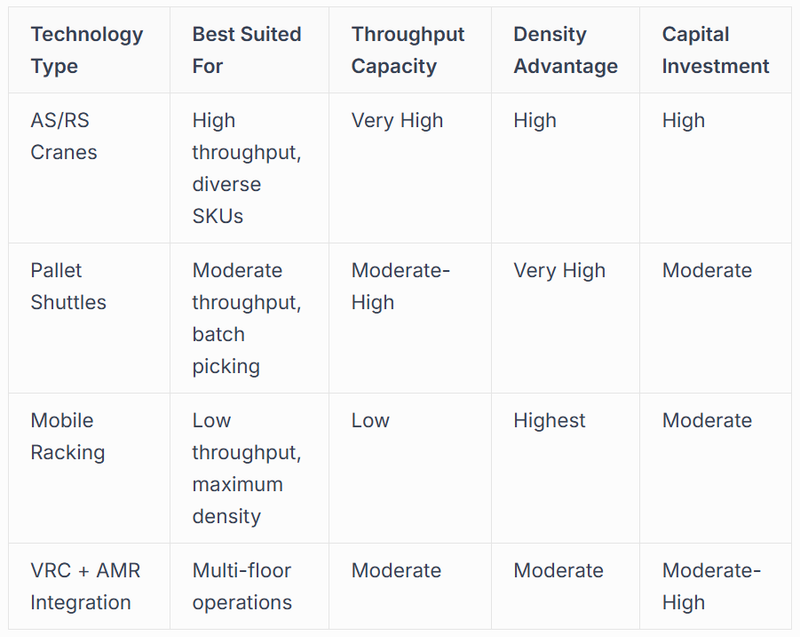
Integrating Vertical Reciprocating Conveyors with AMRs demonstrates how combining complementary technologies creates highly automated solutions suited to complex multi-level facilities.
Scalability planning ensures systems accommodate future growth without requiring complete replacement. Modular system designs allow capacity expansion through additional aisles, extended racking, or supplementary equipment. Building infrastructure to support eventual expansion, even if initial installation uses only partial capacity, proves more cost-effective than retrofitting later.
Advanced Technologies and Future Developments
The automated pallet storage landscape continues evolving as emerging technologies enhance capabilities and expand application possibilities. Staying informed about these developments helps organisations make future-proof investment decisions.
Autonomous mobile robots increasingly complement or replace traditional fixed automation. AGV warehouse automation provides flexible material movement without requiring fixed infrastructure like rails or conveyors. Recent research on language-guided pallet detection for autonomous forklifts demonstrates how AI capabilities enable more sophisticated automated handling.
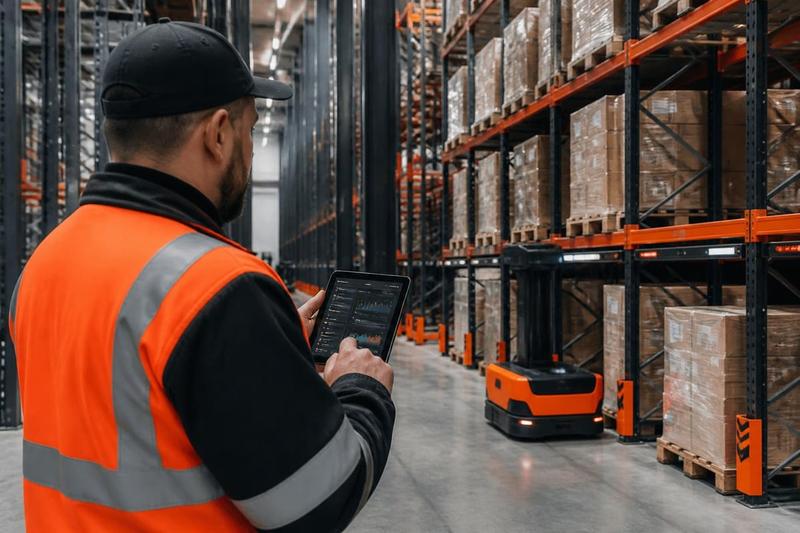
Machine vision and artificial intelligence transform pallet identification and positioning accuracy. Advances in pallet detection using synthetic data highlight how automation continues improving through sophisticated sensing and decision-making capabilities.
Integration with Goods-to-Person Systems
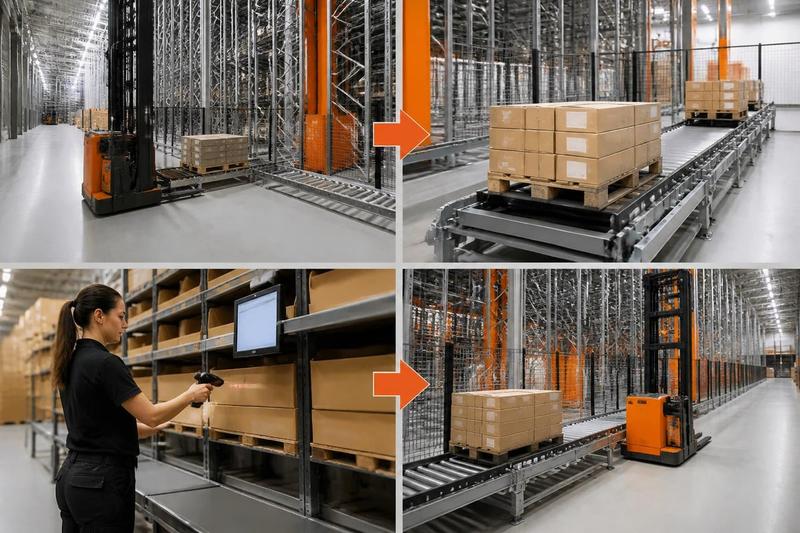
Modern warehouse automation increasingly combines automated pallet storage with goods-to-person picking systems to create end-to-end automated workflows. Rather than retrieving full pallets to floor locations for manual case picking, integrated systems automatically break down pallets and present individual cases or layers to picking stations.
This integration eliminates intermediate handling steps and maximises labour productivity. Automated pallet storage feeds buffer zones where robotic depalletisers break loads into smaller units. These units then flow to ergonomic picking workstations where operators handle only the specific items required for orders.
For ASRS implementations in manufacturing environments, similar integration connects production line output directly to automated storage, creating seamless material flow from manufacturing through distribution.
Sector-Specific Applications
Different industry sectors leverage automated pallet storage to address unique operational challenges and regulatory requirements. Understanding these sector-specific applications helps organisations identify relevant implementation approaches.
Cold storage operations derive exceptional value from automated pallet storage by minimising human exposure to extreme temperatures. Automated systems operate reliably in environments as low as -30°C, maintaining consistent performance where human productivity inevitably suffers. Energy efficiency improves as automated equipment generates less heat than conventional forklifts and requires narrower aisles that reduce conditioned space requirements.
Pharmaceutical warehousing benefits from the precise environmental control and traceability automated systems provide. Temperature monitoring integrates with storage locations, ensuring compliance with storage protocols. Automated movements eliminate contamination risks associated with manual handling whilst maintaining the audit trails regulatory frameworks demand.
FMCG and food & beverage operations utilise automated pallet storage to manage vast SKU portfolios and rapid inventory turnover. First-in-first-out (FIFO) rotation becomes automatic, reducing spoilage and ensuring product freshness. High throughput capabilities support the volume demands typical of these sectors whilst maintaining the accuracy critical for retail distribution.
E-commerce fulfilment increasingly relies on automated pallet storage as order volumes overwhelm manual operations. The ability to operate continuously supports same-day and next-day delivery commitments. Integration with order management systems enables real-time inventory allocation across multiple sales channels.
Return on Investment and Financial Justification
Quantifying the financial returns from automated pallet storage investments requires comprehensive analysis extending beyond simple labour cost displacement. Multiple cost and revenue factors contribute to overall project economics.
Capital investment typically ranges from $500,000 for basic systems to $15 million or more for complex multi-aisle installations. Equipment costs, installation, building modifications, and integration work all contribute to total investment. Financing options including operating leases, capital leases, and rent-to-own arrangements provide alternatives to outright purchase.
Labour cost savings form the most visible return component. Reducing forklift operator headcount and redeploying personnel to higher-value activities generates ongoing savings. For operations running multiple shifts, the compounding effect of labour savings across all shifts accelerates payback.
Space cost implications can substantially impact ROI, particularly in high-cost real estate markets. Avoiding building expansion or additional leased space by increasing storage density within existing facilities represents capital avoidance that improves project economics. Some organisations fund automation investments entirely through space savings.
Operational improvements beyond direct labour reduction contribute additional value. Reduced product damage from automated handling, improved inventory accuracy eliminating stock discrepancies, and faster order cycle times supporting revenue growth all enhance returns. Quantifying these secondary benefits often proves challenging but substantially impacts total value realisation.
Payback Period Expectations
Typical payback periods for automated pallet storage range from three to seven years depending on operational scale, labour rates, and utilisation levels. High-volume operations with multiple shifts achieve faster payback through maximum utilisation of capital investments. Smaller operations with single-shift patterns experience longer payback periods but still achieve compelling long-term returns.
Annual operating costs including maintenance, electricity, and software licensing typically run 5-8% of capital investment. Preventative maintenance programmes prove essential for maintaining equipment reliability and avoiding costly unplanned downtime. Many organisations establish service agreements with system suppliers ensuring priority support and parts availability.
Operational Management and Optimisation
Maximising automated pallet storage performance requires ongoing management attention and continuous improvement initiatives. Even highly automated systems benefit from regular optimisation and operator expertise.
Performance monitoring through key metrics enables proactive management. Tracking equipment utilisation rates, throughput per hour, error rates, and maintenance incidents identifies improvement opportunities and potential issues before they impact operations. Modern systems provide comprehensive dashboards offering real-time visibility into all operational parameters.
Slotting optimisation should occur regularly as product velocity patterns evolve. Seasonal demand shifts, promotional activities, and SKU rationalisation all necessitate storage location adjustments. Automated systems make slotting changes easier than manual warehouses, but organisations must actively manage the process.
Operator training remains critical despite high automation levels. Personnel must understand system capabilities, exception handling procedures, and safety protocols. Cross-training ensures operations maintain productivity during staff absences or turnover.
Preventative maintenance schedules must be rigorously followed to maintain system reliability. Equipment operating continuously faces significant wear requiring regular inspection and component replacement. Predictive maintenance approaches using sensor data to anticipate failures before they occur increasingly supplement scheduled maintenance programmes.
Automated pallet storage delivers transformative operational improvements for organisations facing storage density constraints, labour challenges, or accuracy requirements that manual operations cannot satisfy. By combining proven technologies with intelligent software orchestration, these systems create warehouse environments that operate with unprecedented efficiency and reliability. Automate-X specialises in designing and implementing intelligent warehouse automation solutions tailored to the unique requirements of logistics, 3PL, manufacturing, and distribution operations across Australia and New Zealand. Contact us to explore how automated pallet storage can transform your warehouse operations and support your growth objectives.