

Automated Production: Transform Your Warehouse Operations
Share on
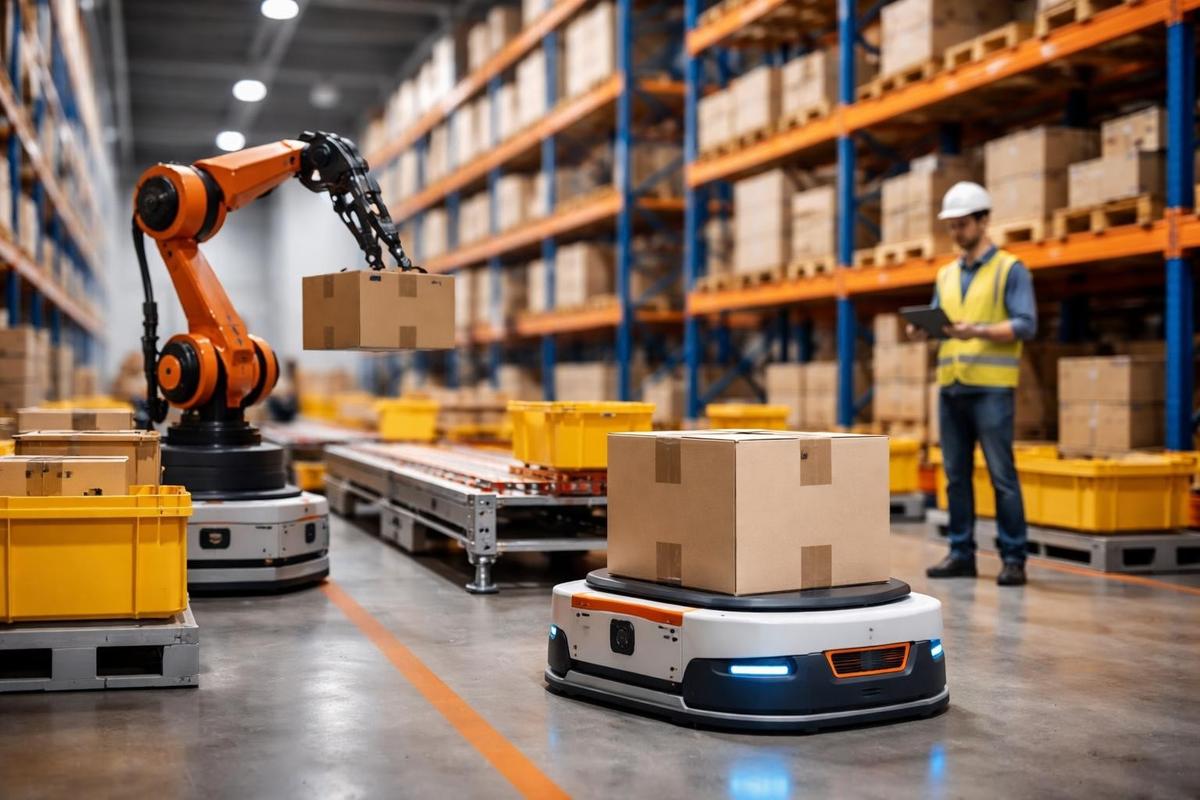
Automated production has fundamentally transformed how warehouses and distribution centres operate in 2026, shifting from manual, labour-intensive processes to intelligent, technology-driven systems that maximise efficiency and accuracy.
This evolution represents more than simple mechanisation; it embodies a comprehensive integration of robotics, software intelligence, and data-driven decision-making that enables logistics operations to scale rapidly whilst maintaining precision.
For businesses navigating competitive supply chain environments, understanding and implementing automated production strategies has become essential to maintaining operational excellence and meeting customer expectations.
The Foundation of Automated Production Systems
Modern automated production in warehouse environments builds upon interconnected layers of technology working in synchronised harmony. At the core, these systems combine physical automation equipment with sophisticated software platforms that orchestrate movement, track inventory, and optimise workflows in real-time.
The physical infrastructure typically includes automated storage and retrieval systems (AS/RS), conveyor networks, robotic picking solutions, and autonomous guided vehicles (AGVs) that transport goods throughout the facility. These components operate under the direction of warehouse management systems and control software that coordinate thousands of simultaneous operations.
Integration Architecture
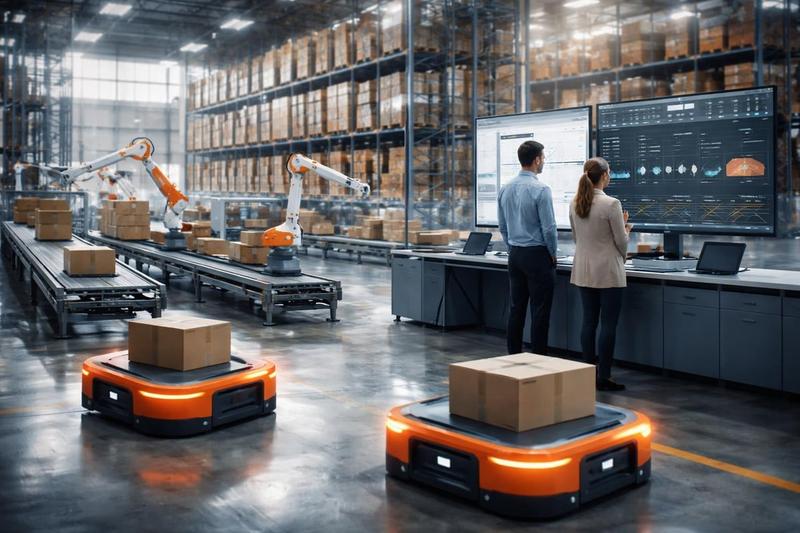
Successful automated production environments require robust integration architectures that connect multiple systems seamlessly. The software evolution in automated production systems has created increasingly modular approaches that allow businesses to implement automation incrementally rather than requiring complete facility overhauls.
Key integration points include:
- Enterprise resource planning (ERP) systems for order management
- Warehouse management systems (WMS) for inventory control
- Warehouse execution systems (WES) for task orchestration
- Equipment control systems for robotics and conveyors
- Analytics platforms for performance monitoring
This modular approach allows operations to start with targeted automation initiatives and expand systematically as processes mature and business requirements evolve.
Technologies Driving Warehouse Automation
The technological landscape supporting automated production in warehousing has expanded dramatically, offering diverse solutions tailored to specific operational challenges. Understanding these warehouse automation technologies helps businesses select appropriate tools for their unique requirements.
Robotics and Material Handling
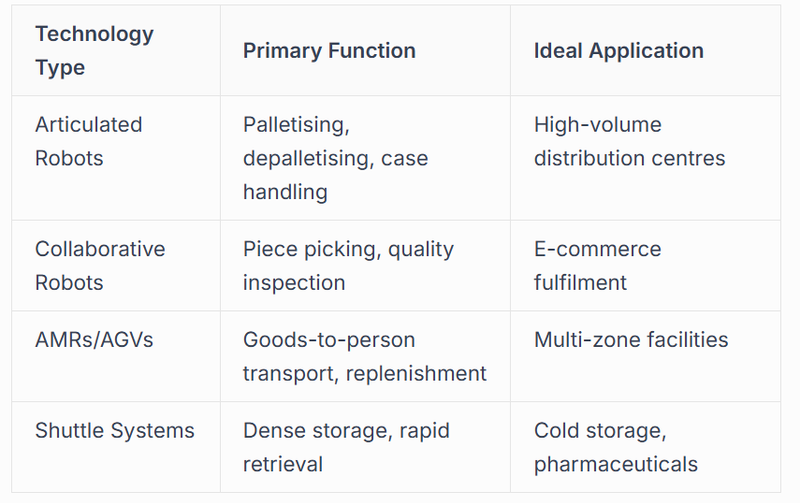
Robotic systems have evolved beyond simple repetitive tasks to handle complex decision-making through artificial intelligence and machine learning. AI integration in warehouse operations enables systems to adapt to changing conditions, learn optimal paths, and predict maintenance requirements before failures occur.
Intelligent Software Systems
Software intelligence serves as the nervous system of automated production environments. Modern warehouse control platforms analyse real-time data streams from thousands of sensors, making split-second decisions about resource allocation, order prioritisation, and workflow optimisation.
These systems continuously monitor performance metrics:
- Order cycle times and throughput rates
- Equipment utilisation and availability
- Labour productivity and allocation
- Inventory accuracy and turnover
- Energy consumption patterns
Advanced algorithms predict demand fluctuations, optimise storage locations based on velocity patterns, and dynamically adjust workflows to maintain peak efficiency during varying operational conditions.
Implementation Strategies for Automated Production
Transitioning to automated production requires strategic planning that balances technological capability with operational reality. Research on production process evolution towards Industry 4.0 demonstrates that successful implementations follow structured stages rather than attempting complete transformation overnight.
Phased Deployment Approach
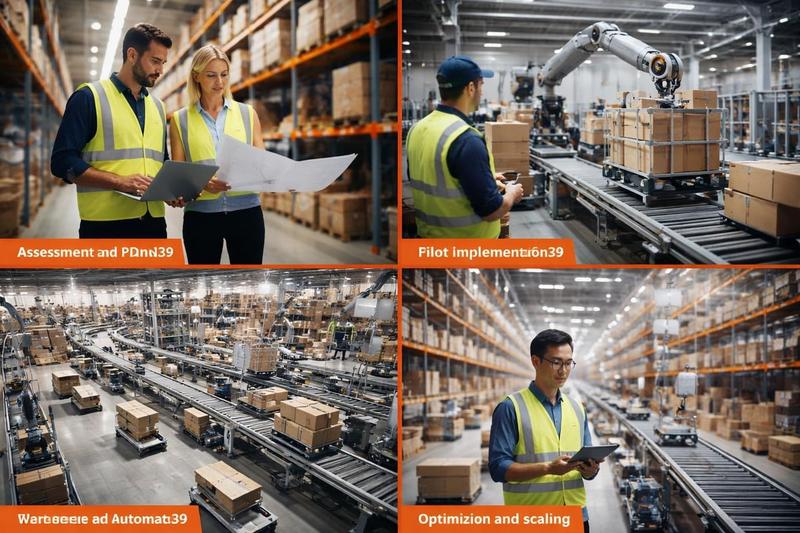
Beginning with comprehensive operational assessment establishes the foundation for effective automation strategy. Businesses must analyse current workflows, identify bottlenecks, quantify labour costs, and measure existing performance baselines before selecting technologies.
Phase one typically focuses on high-impact, lower-risk automation opportunities. For many operations, this means automating repetitive, high-volume tasks such as:
- Conveyor systems for horizontal transport
- Automated sortation for order consolidation
- Barcode scanning and verification systems
- Basic pick-to-light or voice-directed picking
Small and medium-sized businesses often benefit from scalable entry solutions. The Automate-X GTP Starter Grid provides an accessible approach to goods-to-person automation, allowing operations to begin their automated production journey without massive capital investment whilst establishing operational competency with advanced systems.
Change Management Considerations
Technology implementation represents only one dimension of automated production transformation. Human factors significantly influence success rates, requiring deliberate change management strategies that address workforce concerns and build operational competency.
Effective training programmes should cover:
- System operation and monitoring procedures
- Troubleshooting common issues independently
- Understanding data dashboards and performance metrics
- Safety protocols for human-robot collaboration
- Escalation procedures for technical problems
Transparent communication about automation objectives helps teams understand that technology augments human capability rather than replacing workers entirely. Most successful implementations redeploy personnel to higher-value activities requiring problem-solving, quality control, and customer service skills.
Measuring Automated Production Performance
Quantifying automated production results requires comprehensive metrics frameworks that capture both operational efficiency gains and financial returns. Research on automation benefits confirms significant improvements across multiple performance dimensions when systems are properly implemented and maintained.
Operational Metrics
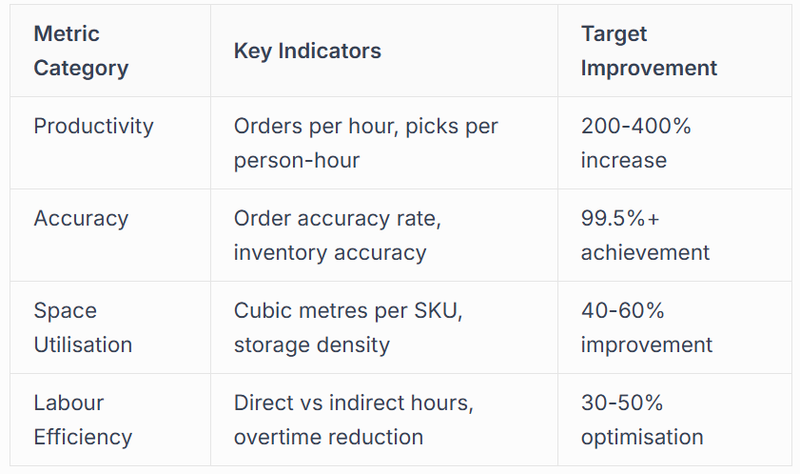
Beyond these fundamental metrics, advanced operations track system availability, mean time between failures (MTBF), and overall equipment effectiveness (OEE) to ensure automated production systems maintain consistent performance over time.
Financial Impact Analysis
Calculating return on investment for automated production requires comprehensive cost modeling that extends beyond equipment acquisition. Total cost of ownership includes:
- Capital equipment and installation expenses
- Software licensing and integration costs
- Facility modifications and infrastructure upgrades
- Training and change management investments
- Ongoing maintenance and support contracts
Balanced against these investments, businesses typically realise savings through reduced labour costs, decreased error rates and returns, improved space utilisation, lower insurance premiums due to enhanced safety, and increased throughput capacity without facility expansion.
Most warehouse automation projects targeting medium to high-volume operations achieve payback periods between 18-36 months, with ongoing operational savings continuing for 10-15 years of system lifecycle.
Industry-Specific Automated Production Applications
Different sectors leverage automated production technologies in ways tailored to their unique operational requirements and regulatory environments. Understanding these specialised applications helps businesses identify relevant automation strategies.
E-commerce and Retail Fulfilment
E-commerce operations face extreme variability in order composition, with individual consumer orders containing one to dozens of items across thousands of SKUs. Automated production systems for these environments prioritise flexibility and speed:
- Goods-to-person systems that bring products to stationary pickers
- Automated packaging systems that right-size boxes
- Sortation systems that consolidate multi-item orders
- Real-time inventory visibility across multiple sales channels
Peak season scalability represents a critical requirement, as these operations may experience 300-500% volume increases during promotional periods whilst maintaining same-day or next-day delivery commitments.
Pharmaceutical and Healthcare Distribution
Pharmaceutical warehouses operate under stringent regulatory requirements demanding complete traceability and controlled environmental conditions. Automated production implementations prioritise:
- Serialisation and track-and-trace capabilities at unit level
- Temperature-controlled storage with continuous monitoring
- Batch and expiry date management with FEFO rotation
- Quarantine and quality hold workflows
- Chain of custody documentation for controlled substances
These environments benefit from automation's consistency and documentation capabilities, which support regulatory compliance whilst improving operational efficiency.
Food and Beverage Operations
Cold storage and temperature-sensitive product handling creates unique automation challenges. Successful automated production systems in food and beverage distribution address:
- Multi-temperature zone management (frozen, refrigerated, ambient)
- First-expired-first-out (FEFO) inventory rotation
- Lot tracking for recall management
- Sanitation protocols between production runs
- Condensation management to prevent equipment issues
Robotic systems designed for cold environments feature specialised components resistant to temperature extremes and moisture, ensuring reliable operation in challenging conditions.
Advanced Capabilities in Modern Automated Production
The frontier of warehouse automation continues advancing rapidly, with emerging capabilities that further enhance operational performance and adaptability. Current research explores fully automated production systems driven by generative AI and autonomous robotics that represent the next evolution in manufacturing and logistics.
Artificial Intelligence and Machine Learning
AI integration transforms automated production from following predetermined rules to making intelligent decisions based on pattern recognition and predictive analytics. Machine learning algorithms optimise:
- Dynamic slotting that continuously repositions inventory based on velocity changes
- Predictive maintenance identifying equipment issues before failures occur
- Demand forecasting improving inventory positioning and replenishment
- Route optimisation for autonomous vehicles navigating facilities
- Anomaly detection flagging unusual patterns requiring investigation
These capabilities enable systems to improve performance continuously without manual intervention, adapting to seasonal patterns, promotional activities, and evolving product mixes automatically.

Digital Twin Technology
Digital twins create virtual replicas of physical warehouse environments, enabling sophisticated simulation and testing before implementing changes. Research on digital twin testing architectures emphasises the importance of fidelity in representing physical manufacturing and logistics environments accurately.
Operations teams use digital twins to:
- Test layout modifications virtually before physical changes
- Simulate seasonal demand scenarios and capacity planning
- Train staff in safe virtual environments
- Optimise system configurations through rapid iteration
- Troubleshoot issues by recreating problem conditions
This technology reduces implementation risk and accelerates continuous improvement initiatives by allowing experimentation without disrupting live operations.
Integration with Broader Supply Chain Networks
Automated production in warehousing extends beyond individual facility optimisation to encompass multi-site coordination and supply chain network integration. Modern logistics operations require seamless data exchange and process coordination across distributed facilities.
Multi-Site Orchestration
Businesses operating multiple distribution centres leverage centralised visibility and coordination platforms that treat the entire network as a unified automated production system. These platforms enable:
- Inventory balancing across locations based on regional demand
- Order routing to optimal fulfilment points considering proximity, inventory, and capacity
- Shared resource pools where mobile automation equipment can be redeployed
- Consistent processes ensuring service level uniformity regardless of facility
- Consolidated reporting providing enterprise-wide performance visibility
This network approach maximises the investment in automation of operations by treating capacity as a flexible resource rather than fixed facility-specific assets.
Supplier and Customer Integration
Extending automated production benefits requires integration with external partners throughout the supply chain. Electronic data interchange (EDI), application programming interfaces (APIs), and real-time tracking platforms enable:
- Advanced shipping notices (ASNs) triggering automated receiving workflows
- Cross-docking operations bypassing storage for direct transfer
- Vendor-managed inventory programs with automated replenishment
- Customer portals providing real-time order visibility
- Returns processing with automated inspection and restocking
These integrations eliminate manual data entry, reduce delays, and improve accuracy throughout the extended supply chain network.
Maintenance and Continuous Improvement
Sustaining automated production performance requires disciplined maintenance programmes and commitment to continuous improvement. Analysis of software maintainability in automated systems highlights that long-term success depends on systematic approaches to system updates and cross-disciplinary development coordination.
Preventive Maintenance Frameworks
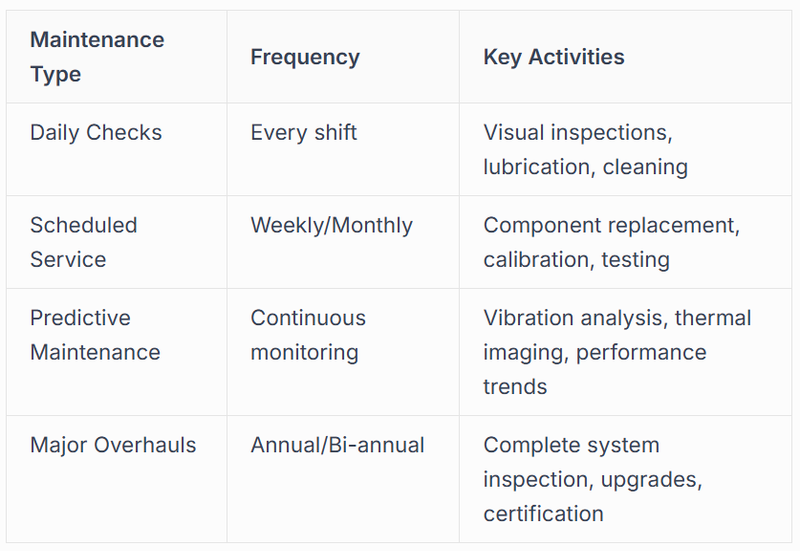
Sophisticated operations implement computerised maintenance management systems (CMMS) that track all service activities, manage spare parts inventory, and schedule preventive work automatically based on equipment runtime or calendar intervals.
Performance Optimisation Cycles
Automated production systems should undergo regular performance reviews examining operational data to identify improvement opportunities. Effective optimisation cycles include:
- Monthly operational reviews analysing throughput, accuracy, and efficiency metrics
- Quarterly system audits evaluating configuration settings and workflow logic
- Annual strategic assessments considering technology upgrades and expansion opportunities
- Continuous monitoring of real-time dashboards identifying immediate issues
Businesses achieving sustained excellence from automated production treat optimisation as an ongoing discipline rather than a one-time implementation project, investing in custom automation solutions that evolve with changing operational requirements.
Risk Management and Business Continuity
While automated production delivers substantial benefits, concentrated reliance on technology-dependent systems introduces operational risks requiring mitigation strategies. Comprehensive risk management addresses technology failures, cybersecurity threats, and business continuity requirements.
Redundancy and Backup Systems
Critical automated production environments implement redundancy at multiple levels:
- Dual power supplies with automatic failover and backup generators
- Redundant network infrastructure preventing single points of communication failure
- Backup control systems enabling continued operation during primary system issues
- Manual override capabilities allowing staff intervention when necessary
- Spare parts inventory for critical components with long lead times
These redundancies balance investment cost against downtime risk, with critical 24/7 operations implementing more extensive backup systems than facilities with flexible operating schedules.
Cybersecurity Considerations
Interconnected automated production systems create potential cybersecurity vulnerabilities requiring protective measures. Essential security practices include:
- Network segmentation isolating operational technology from corporate networks
- Access controls limiting system permissions to authorised personnel
- Regular security updates patching known vulnerabilities promptly
- Intrusion detection monitoring for unauthorised access attempts
- Disaster recovery planning enabling rapid restoration after incidents
As warehouse automation systems increasingly connect to cloud platforms and external partners, cybersecurity evolves from IT department responsibility to core operational concern requiring ongoing attention and investment.
Automated production represents a transformative opportunity for warehouse and logistics operations seeking to improve efficiency, accuracy, and scalability in increasingly competitive markets. By strategically implementing appropriate technologies, developing workforce capabilities, and maintaining disciplined optimisation practices, businesses can achieve substantial operational improvements whilst positioning themselves for continued growth. Automate-X combines advanced robotics, intelligent software platforms, and deep industry expertise to help logistics operations across Australia and New Zealand successfully navigate their automation journeys, delivering tailored solutions that address specific operational challenges whilst enabling long-term scalability.