

Automation Businesses: Strategies for Growth in 2026
Share on
The landscape of automation businesses has transformed dramatically over the past decade, evolving from niche technology providers into essential partners for organisations seeking operational excellence. As we progress through 2026, automation businesses find themselves at the intersection of artificial intelligence, robotics, and enterprise-scale integration. These companies are no longer simply selling equipment or software; they're architecting comprehensive solutions that reshape how warehouses, manufacturing facilities, and distribution centres operate. The shift towards intelligent automation and robotics has created unprecedented opportunities for businesses that can deliver measurable ROI while navigating complex implementation challenges.
The Current State of Automation Businesses
Automation businesses today operate in a fundamentally different environment compared to five years ago. The market has matured beyond proof-of-concept demonstrations and pilot programs, with clients demanding proven, scalable solutions that integrate seamlessly with existing infrastructure.
Market Dynamics Shaping Growth
The global automation market reflects several critical trends that successful automation businesses must navigate:
- Client sophistication has increased dramatically, with procurement teams now understanding automation terminology and expecting detailed ROI projections
- Integration complexity requires automation businesses to offer comprehensive ecosystem management rather than standalone products
- Service-based models are replacing traditional capital expenditure approaches, creating recurring revenue opportunities
- Industry specialisation has become essential, as generic solutions fail to address sector-specific challenges
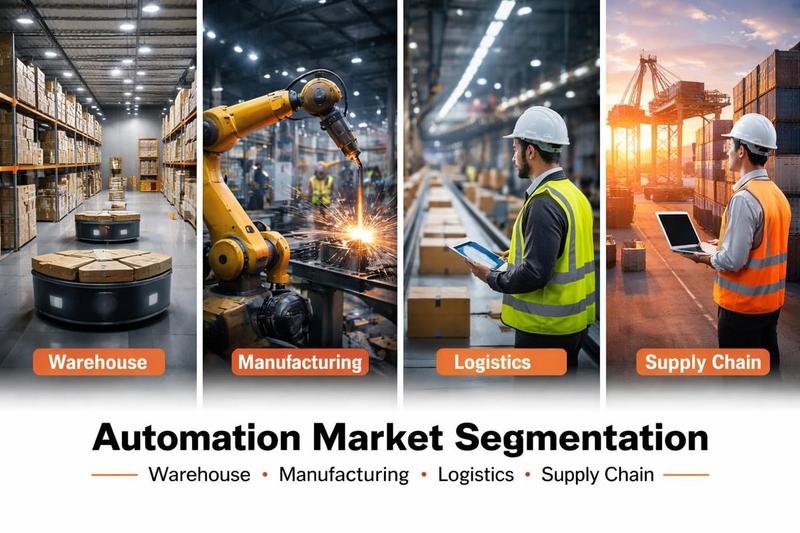
Financial performance among automation businesses varies considerably based on vertical focus and solution maturity. Companies serving e-commerce fulfillment and third-party logistics providers have experienced particularly strong growth, driven by continued online shopping expansion and supply chain resilience initiatives.
Technology Stack Evolution
Modern automation businesses must master an increasingly diverse technology portfolio. The convergence of physical robotics, warehouse management systems, artificial intelligence, and cloud-based orchestration platforms has created both opportunities and complexities.
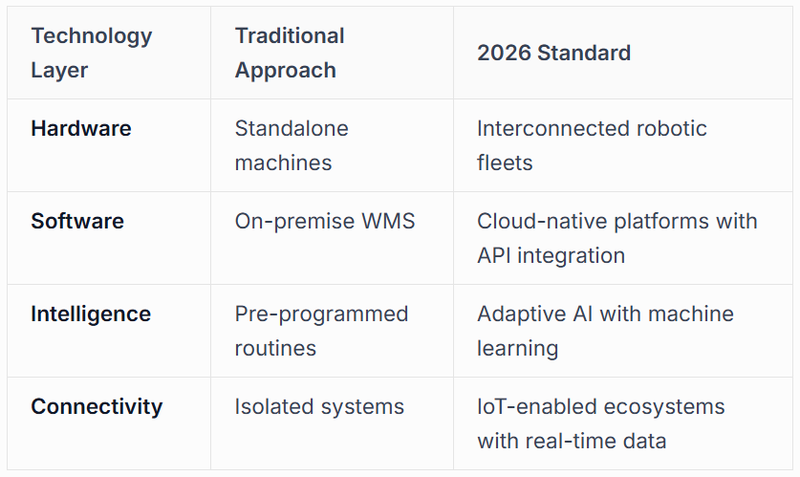
The evolution of agentic AI in automation represents a fundamental shift in how automation businesses design and deliver solutions. Rather than simply automating repetitive tasks, modern systems make context-aware decisions that optimise operations across multiple variables simultaneously.
Building a Sustainable Automation Business Model
Establishing and scaling automation businesses requires strategic clarity around value proposition, target markets, and operational capabilities. The most successful companies have moved beyond technology-first thinking to adopt customer outcome-focused models.
Defining Your Value Proposition
Automation businesses must articulate clear, measurable benefits that resonate with financial decision-makers. Operational managers may appreciate technical specifications, but CFOs require concrete evidence of cost reduction, throughput improvement, or capacity expansion.
Key performance indicators that automation businesses should emphasise include:
- Labour productivity gains expressed as percentage improvement in units processed per labour hour
- Accuracy improvements measured through error rate reduction and quality metrics
- Space utilisation efficiency demonstrating how automation maximises existing facility footprint
- Scalability metrics showing how systems adapt to seasonal peaks or business growth
- Total cost of ownership comparisons including installation, maintenance, and operational expenses
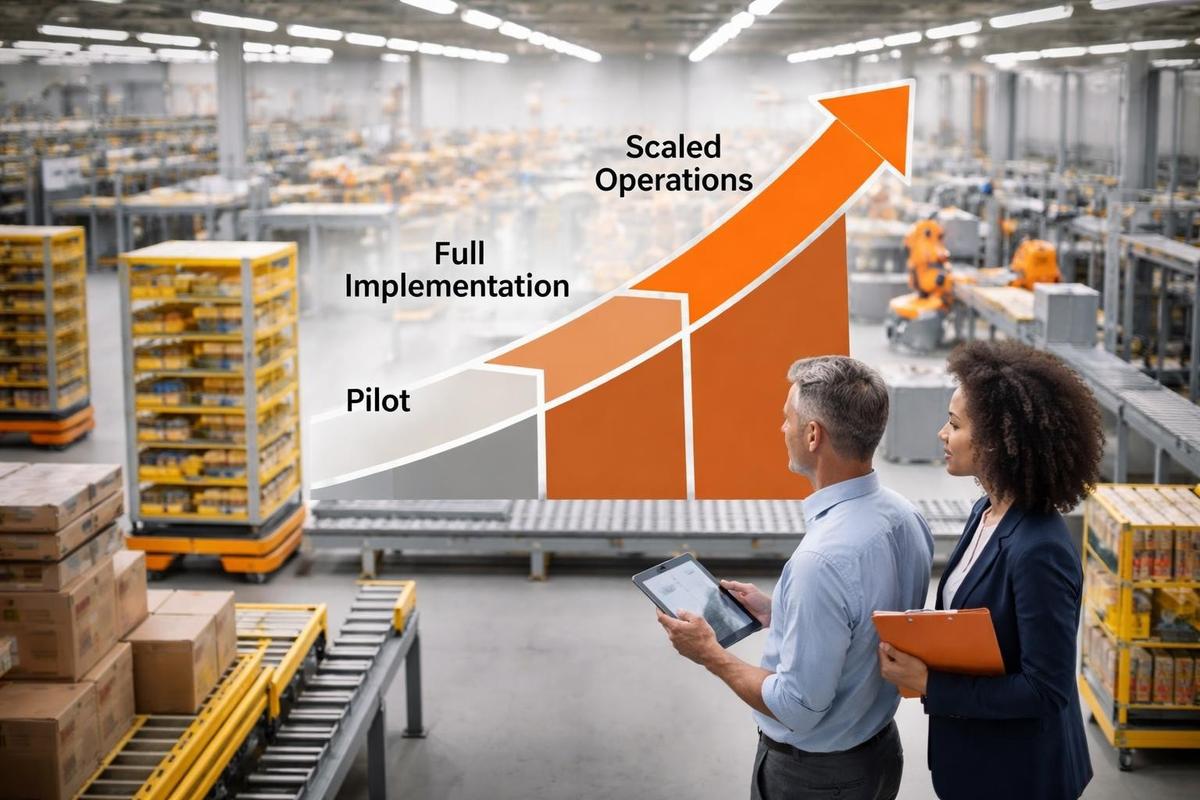
The transition from pilot projects to enterprise-wide deployment represents a critical challenge for automation businesses. As noted in recent industry analysis, the pilot phase is now over, with organisations demanding proof that automation solutions can scale across multiple facilities and operational contexts.
Customer Acquisition Strategies
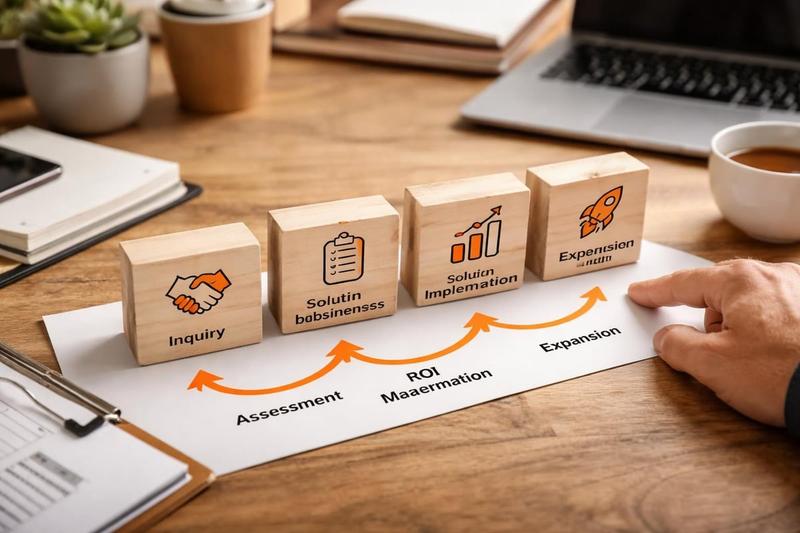
Successful automation businesses employ multi-channel acquisition strategies tailored to lengthy B2B sales cycles. The typical warehouse automation decision involves six to twelve months from initial inquiry through contract signing, requiring sustained engagement and relationship development.
Effective approaches include:
- Vertical market specialisation that demonstrates deep understanding of sector-specific challenges in cold storage, pharmaceuticals, or food and beverage
- Partnership ecosystems with complementary providers offering warehouse management software, material handling equipment, or systems integration services
- Reference customer programmes showcasing measurable results from similar operational environments
- Educational content addressing common pain points and emerging industry trends
For businesses targeting small and medium enterprises, entry-level solutions that reduce initial investment barriers prove essential. Entry points that minimise upfront capital requirements whilst delivering meaningful operational improvements create pathways for expansion into comprehensive automation programmes.
Operational Excellence in Automation Businesses
Delivering automation solutions profitably requires operational capabilities spanning engineering, project management, software development, and ongoing service delivery. Automation businesses must build internal competencies that match the complexity of solutions they provide.
Project Delivery Frameworks
Implementation excellence separates successful automation businesses from those struggling with cost overruns and disappointed clients. Structured methodologies ensure consistent outcomes across diverse customer environments.
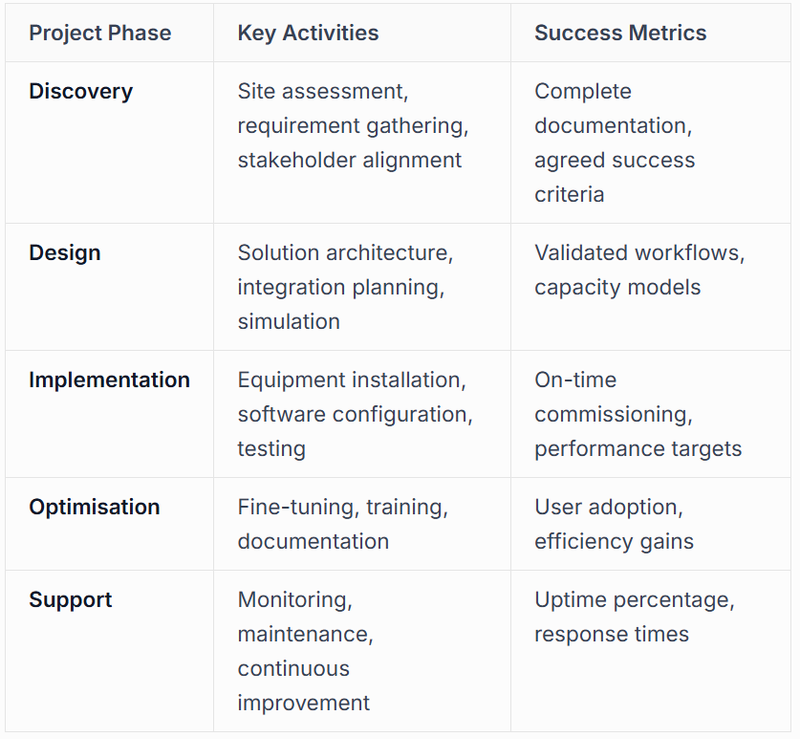
Risk management throughout the delivery lifecycle requires automation businesses to identify potential integration challenges early. Legacy warehouse management systems, physical facility constraints, and change management resistance represent common obstacles that disciplined project governance addresses.
Building Technical Capabilities
Automation businesses require multi-disciplinary teams combining mechanical engineering, software development, data science, and industry domain expertise. The talent acquisition and development challenge has intensified as demand for automation specialists outpaces supply.
Successful companies invest in structured training programmes that develop internal expertise whilst creating career progression pathways. Cross-functional collaboration between hardware engineers and software developers ensures solutions deliver integrated value rather than disconnected components.
Industry-Specific Applications and Opportunities
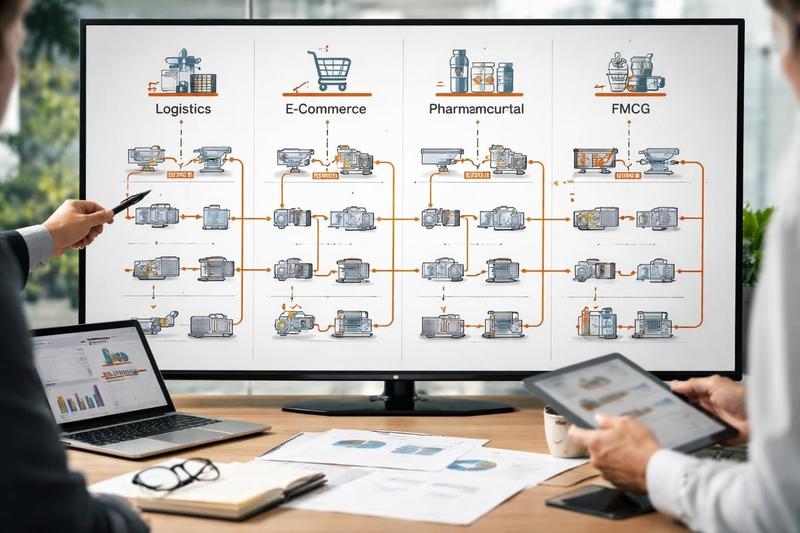
Automation businesses achieve strongest results through vertical specialisation that addresses unique operational requirements. Generic solutions fail to accommodate the specific workflows, regulatory requirements, and performance expectations across different industries.
Logistics and Third-Party Logistics (3PL)
The 3PL sector represents a particularly attractive market for automation businesses due to high transaction volumes, labour constraints, and pressure for operational efficiency. These facilities manage diverse SKU profiles with variable throughput demands, creating complexity that automation addresses effectively.
Critical requirements for 3PL automation include:
- Rapid reconfiguration capabilities to accommodate changing client product mixes
- Multi-client inventory management ensuring accurate segregation and tracking
- Scalable capacity that adjusts to seasonal peaks and business growth
- Real-time visibility providing clients with inventory status and order progress
Automation businesses serving this sector must demonstrate flexibility and rapid deployment capabilities, as 3PL providers require solutions that minimise implementation disruption whilst delivering immediate productivity improvements.
E-commerce Fulfillment
E-commerce operations demand automation solutions optimised for high-velocity, small-order processing. The shift from bulk distribution to individual consumer orders has fundamentally changed warehouse operations, creating opportunities for automation businesses offering goods-to-person systems, automated sortation, and intelligent order orchestration.
Consumer expectations for same-day or next-day delivery compress fulfillment windows, requiring automation that maximises throughput whilst maintaining accuracy. Peak season capacity planning represents a critical challenge that scalable automation addresses more cost-effectively than temporary labour expansion.
Pharmaceutical and Healthcare
Pharmaceutical warehousing introduces stringent regulatory compliance, temperature control requirements, and traceability standards that automation businesses must accommodate. Solutions must provide complete audit trails, ensure product integrity, and support batch tracking throughout the supply chain.
The combination of high-value inventory, zero-error tolerance, and complex handling requirements creates a premium market for automation businesses offering specialised capabilities. Temperature-controlled storage automation, automated dispensing systems, and serialisation tracking represent specific solution areas with strong demand.
Technology Trends Reshaping Automation Businesses
Automation businesses must continuously evolve their solution portfolios to incorporate emerging technologies whilst maintaining reliability and supportability. The pace of technological change has accelerated, creating both opportunities for differentiation and risks of premature adoption.
Artificial Intelligence and Machine Learning Integration
AI capabilities have moved from experimental features to core requirements within automation solutions. Modern warehouse automation systems leverage machine learning for demand forecasting, route optimisation, predictive maintenance, and adaptive process control.
Automation businesses that successfully integrate AI deliver systems that improve performance over time through continuous learning. This creates competitive differentiation compared to static, pre-programmed automation that requires manual adjustment as operational conditions change.
Current industrial automation trends highlight the acceleration towards autonomous systems capable of independent decision-making within defined parameters. This evolution requires automation businesses to develop data science capabilities alongside traditional engineering expertise.
Cloud-Based Orchestration and Connectivity
The migration towards cloud-native architectures enables automation businesses to offer centralized management across multi-site operations. Clients with distributed warehouse networks can monitor performance, update configurations, and analyse operations through unified platforms rather than managing disconnected systems.
Benefits of cloud-based automation include:
- Remote diagnostics and support reducing on-site service requirements and downtime
- Continuous software updates delivering new features and performance improvements
- Centralised data analytics enabling enterprise-wide optimization and benchmarking
- Flexible deployment models supporting hybrid on-premise and cloud configurations
- Enhanced security through professional infrastructure management and threat monitoring
Connectivity standards and interoperability protocols have become critical considerations as automation businesses integrate with diverse enterprise systems. API-first architectures ensure solutions connect seamlessly with warehouse management systems, enterprise resource planning platforms, and transportation management software.
Robotics Advancement and Autonomous Mobile Robots
The proliferation of autonomous mobile robots (AMRs) has created new business models for automation businesses. These flexible systems offer faster deployment, lower infrastructure requirements, and easier reconfiguration compared to traditional fixed automation.
Successful automation businesses now offer hybrid solutions combining stationary systems for high-throughput processes with mobile robotics for dynamic tasks. This approach optimises capital efficiency whilst providing operational flexibility that purely fixed installations cannot match.
Scaling Automation Businesses Strategically
Growth requires deliberate strategies that balance market expansion, solution development, and operational capacity. Automation businesses face choices between geographic expansion, vertical market penetration, and horizontal product diversification.
Geographic Expansion Considerations
International growth introduces complexity around regulatory compliance, service delivery capabilities, and local market dynamics. Automation businesses expanding beyond their home markets must establish service networks capable of responsive support whilst managing inventory for replacement parts and consumables.
Partnership models often provide faster market entry than wholly-owned operations. Collaborating with established systems integrators or material handling distributors provides local market knowledge and existing customer relationships whilst requiring careful management of brand standards and technical competency.
The Australasian market presents specific opportunities for automation businesses given the region's labour costs, geographic distribution challenges, and increasing e-commerce penetration. Both Australia and New Zealand show strong adoption of warehouse automation driven by supply chain modernisation initiatives.
Product Portfolio Development
Automation businesses must balance innovation investment across incremental improvements to existing solutions and breakthrough capabilities addressing emerging needs. Research and development resources are finite, requiring strategic prioritisation aligned with market demand and competitive positioning.
Customer feedback loops prove essential for identifying which enhancements deliver greatest value. Successful automation businesses maintain structured processes for capturing operational data, user experience insights, and performance metrics that inform product roadmaps.
The business automation trends emerging in 2026 emphasise integration capabilities and user-friendly interfaces alongside core automation functionality. Solutions that non-technical users can configure and optimise without extensive programming knowledge expand addressable markets beyond enterprises with dedicated automation teams.
Building Recurring Revenue Models
Transitioning from capital equipment sales to service-based revenue creates more predictable cash flows and stronger customer relationships. Automation-as-a-service models reduce client acquisition barriers whilst generating ongoing revenue through subscription fees.
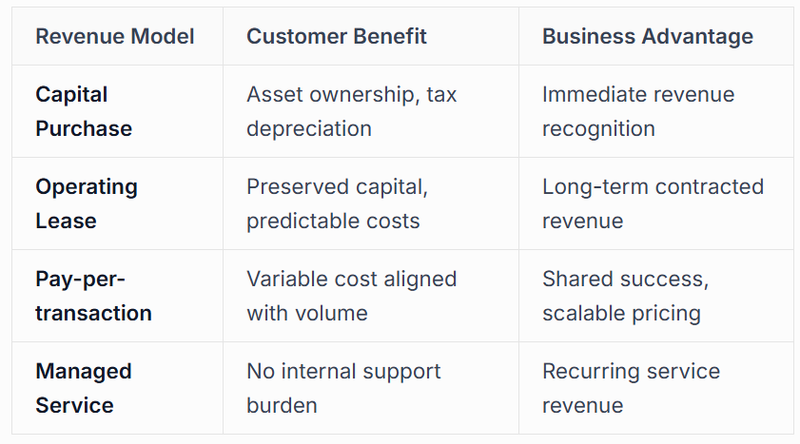
Service contracts for maintenance, software updates, and performance optimization generate margin-rich revenue whilst ensuring automation businesses maintain ongoing customer engagement. These relationships create expansion opportunities as clients recognise additional automation potential.
Measuring Success and Performance Optimisation
Automation businesses must establish clear metrics for both internal operations and customer outcomes. Data-driven performance management enables continuous improvement whilst demonstrating value to clients and stakeholders.
Customer Success Metrics
Tracking client outcomes provides validation of solution effectiveness whilst identifying optimization opportunities. Automation businesses should implement systematic measurement protocols capturing:
- Throughput improvements showing actual versus projected processing capacity increases
- Labour productivity gains quantifying efficiency improvements per worker or per hour
- Accuracy metrics documenting error rate reductions and quality enhancements
- System uptime measuring reliability against service level agreements
- ROI achievement comparing financial returns against initial investment projections
Regular business reviews with customers using objective performance data strengthen relationships whilst surfacing opportunities for system enhancements or capacity expansions. These sessions demonstrate commitment to customer success beyond initial installation.
Internal Operational Metrics
Automation businesses require disciplined tracking of delivery performance, financial health, and organisational effectiveness. Key performance indicators should span sales efficiency, project execution, service delivery, and innovation productivity.
Critical internal metrics include:
- Sales cycle duration from initial contact through contract signing
- Project margin percentages comparing actual versus budgeted delivery costs
- Installation timeline adherence measuring on-time, on-budget completion rates
- Service response times tracking mean time to resolution for support requests
- Customer retention rates indicating satisfaction and expansion potential
Process improvement methodologies applied to internal operations ensure automation businesses practice the efficiency principles they promote to customers. Continuous refinement of proposal development, project management, and service delivery creates competitive advantages through superior execution.
Automation businesses in 2026 operate in a dynamic environment where technological capability must align with customer outcomes and operational excellence. Success requires balancing innovation with reliability, customisation with standardisation, and growth ambition with delivery quality.
For organisations seeking to modernise warehouse operations and build scalable fulfillment capabilities, partnering with experienced automation providers delivers measurable competitive advantages. Automate-X combines advanced robotics, intelligent software, and proven implementation methodologies to transform warehouse performance across logistics, e-commerce, manufacturing, and distribution environments throughout Australia and New Zealand.