

Fulfillment Center Automation: A Complete 2026 Guide
Share on
The logistics landscape has transformed dramatically over recent years, with consumer expectations for faster delivery times placing unprecedented pressure on fulfillment operations. Fulfillment center automation has emerged as the strategic response to these challenges, enabling businesses to process higher order volumes with greater accuracy whilst managing labour costs and scalability constraints. This comprehensive guide examines the technologies, benefits, implementation considerations, and future trends shaping automated fulfillment operations across Australia, New Zealand, and global markets.
Understanding Fulfillment Center Automation Technologies
Fulfillment center automation encompasses a broad spectrum of technologies designed to streamline order processing, inventory management, and distribution workflows. The modern automated fulfillment environment integrates multiple systems working in concert to eliminate manual touchpoints and accelerate throughput.
Goods-to-Person Systems
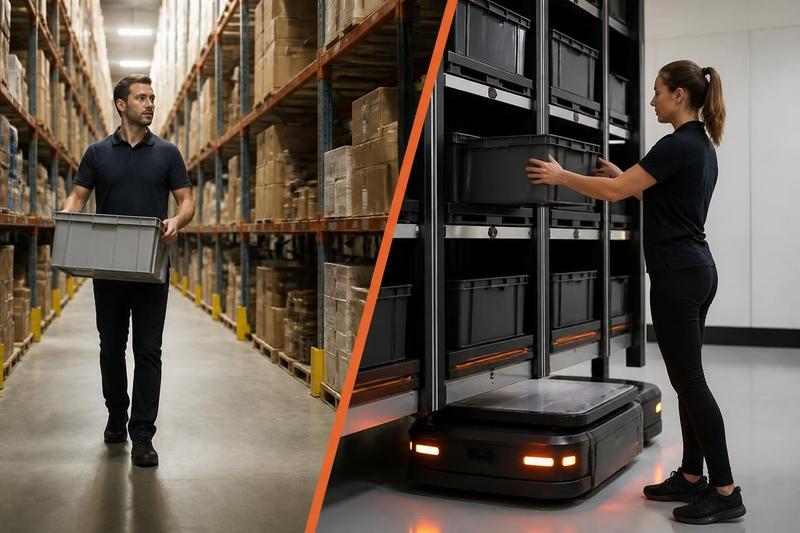
Goods-to-person (GTP) technology fundamentally redesigns the picking process by bringing inventory directly to stationary operators. Rather than workers traversing warehouse aisles, automated storage and retrieval systems deliver required items to ergonomic workstations.
Key GTP technologies include:
- AutoStore grid-based systems with robots retrieving bins from high-density storage cubes
- Vertical lift modules providing automated vertical storage with delivery to pick windows
- Horizontal carousels rotating inventory to picking positions
- Automated mobile robots (AMRs) transporting shelving units to operators
This approach dramatically reduces walking time, which can account for 50-60% of traditional picking labour. Dematic's implementation at Scentsy demonstrates this potential, achieving a 50% increase in picking capacity through AutoStore integration.
Automated Sortation and Conveyance
Sophisticated conveyor networks and sortation systems form the circulatory system of modern fulfillment centers. These technologies automate product movement between receiving, storage, picking, packing, and dispatch zones.
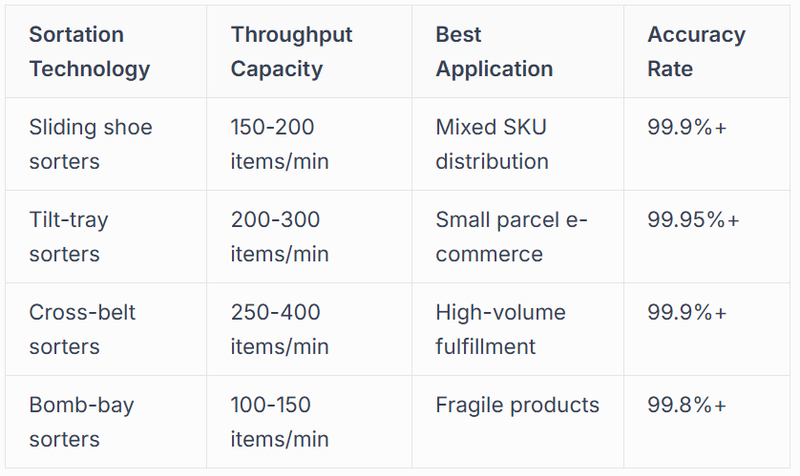
Advanced sortation solutions enable fulfillment operations to process diverse order profiles whilst maintaining accuracy standards that manual operations struggle to achieve consistently.
Robotic Picking and Manipulation
Whilst goods-to-person systems automate inventory delivery, robotic picking technologies automate the physical item selection process. Recent advances in computer vision, gripper technology, and artificial intelligence have enabled robots to handle increasingly diverse product types.
Modern robotic picking systems demonstrate remarkable capabilities. Research from leading institutions shows compliant manipulation systems achieving human-level packing density and speed in e-commerce fulfillment applications, representing a significant milestone for automation adoption.
The fulfillment center automation landscape continues evolving, with collaborative robots (cobots) working alongside human operators in hybrid environments that balance automation benefits with operational flexibility.
Operational Benefits Driving Automation Investment
Businesses implementing fulfillment center automation report transformative impacts across multiple operational dimensions. Understanding these benefits helps justify investment decisions and set realistic expectations for automation projects.
Labour Productivity and Cost Management
Direct labour represents 50-65% of typical fulfillment operating costs. Automation fundamentally reshapes this cost structure by reducing headcount requirements, minimising training demands, and eliminating productivity variations inherent in manual operations.
Productivity improvements typically include:
- 2-3x increase in picks per hour for goods-to-person implementations
- 40-60% reduction in labour hours per order processed
- Elimination of walking time accounting for 10-15 km daily in traditional operations
- Consistent performance unaffected by fatigue or shift variations
Beyond direct cost reduction, automation addresses the increasingly challenging labour market. Recruiting and retaining warehouse workers has become progressively difficult across developed markets, with turnover rates often exceeding 40-50% annually in manual environments.
Accuracy and Quality Enhancement
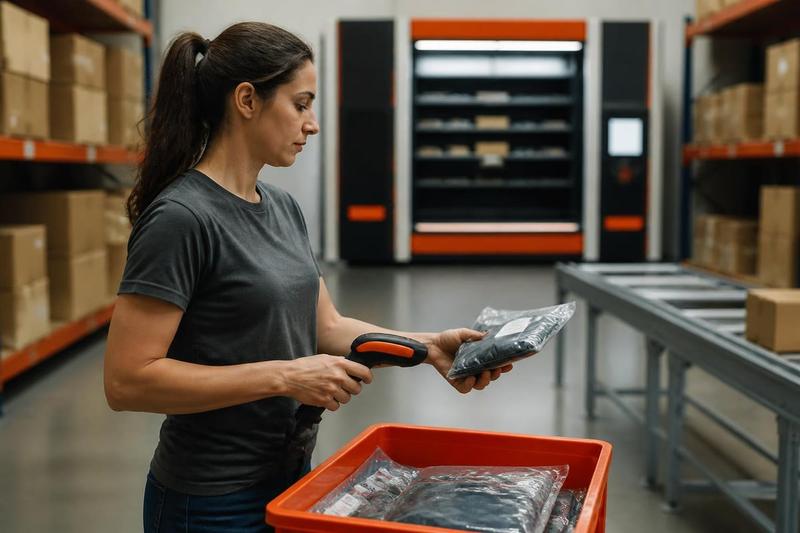
Order accuracy directly impacts customer satisfaction, return rates, and brand reputation. Manual picking operations typically achieve 99.0-99.5% accuracy, meaning 5-10 errors per 1,000 orders. Automated systems routinely exceed 99.9% accuracy.
This improvement stems from multiple factors. Barcode verification at every touchpoint eliminates pick errors. Automated systems follow programmed sequences without deviation. Integration between warehouse management systems and automation controllers ensures correct inventory allocation.
The financial impact extends beyond customer satisfaction. Each picking error generates costs for customer service, return processing, replacement shipment, and potential goodwill gestures. At scale, accuracy improvements deliver substantial bottom-line benefits.
Space Utilisation and Density
Real estate costs represent significant ongoing expenses for fulfillment operations. Fulfillment center automation technologies maximise cubic space utilisation, enabling higher inventory density within existing facilities or reducing facility footprint requirements.
High-density storage systems like AutoStore achieve 4-5x greater storage density compared to conventional racking. Vertical lift modules exploit building height often underutilised in traditional layouts. These space gains translate directly to reduced facility costs or increased capacity without expansion.
Micro-fulfillment center concepts leverage this density advantage, enabling urban fulfillment operations in compact footprints that support same-day delivery promises whilst managing premium real estate costs.
Implementation Considerations and Strategic Planning
Successful fulfillment center automation requires thorough planning, realistic expectations, and alignment between technology capabilities and operational requirements. Several critical considerations influence implementation success.
Operational Assessment and Technology Selection
The automation journey begins with comprehensive operational analysis. Businesses must understand current performance baselines, future volume projections, order profiles, SKU characteristics, and service level requirements before selecting appropriate technologies.
Critical assessment factors include:
- Average and peak daily order volumes with seasonal variation patterns
- Order complexity metrics including lines per order and units per line
- SKU velocity distribution identifying fast, medium, and slow movers
- Product characteristics affecting handling requirements (dimensions, weight, fragility)
- Throughput targets and service level commitments
- Integration requirements with existing warehouse management systems
Technology selection should align with specific operational profiles rather than pursuing automation for its own sake. A distribution center processing bulk replenishment orders requires fundamentally different solutions than an e-commerce fulfillment center handling single-unit consumer orders.
Small to medium operations exploring automation can benefit from modular approaches. The Automate-X GTP Starter Grid provides an accessible entry point, offering a low-cost, scalable foundation for businesses beginning their warehouse automation journey without requiring massive capital commitments.
Investment Analysis and ROI Modeling
Fulfillment center automation represents substantial capital investment, typically ranging from $2 million to $50+ million depending on facility size and technology scope. Rigorous financial analysis ensures projects deliver acceptable returns.
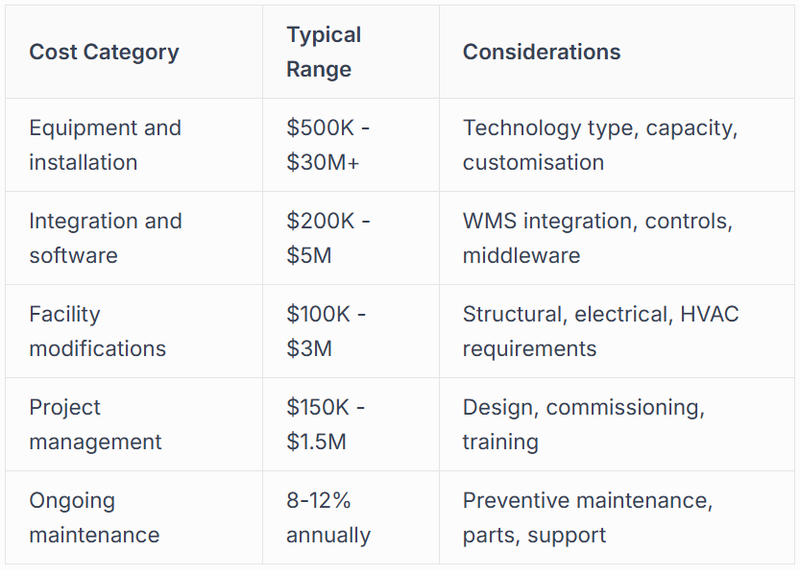
ROI calculations should incorporate both cost reductions and revenue-enabling benefits. Labour savings provide the most immediate returns, but accuracy improvements, capacity expansion, and service level enhancements contribute long-term value. Most implementations target 3-5 year payback periods.
Change Management and Workforce Transition
Technology implementation represents only one dimension of automation success. Effective change management ensures workforce acceptance, maintains operational continuity during transition, and captures intended benefits.
Concerns about job displacement require proactive communication and workforce planning. Whilst automation reduces certain manual roles, it creates demand for technical positions in maintenance, systems operation, and process management. Forward-thinking organisations redeploy existing staff into these evolving roles through comprehensive training programmes.
Maintaining operational continuity during implementation demands careful planning. Phased rollouts, parallel operations during transition periods, and contingency protocols minimise disruption risks. Understanding automated warehouse picking fundamentals helps teams prepare for operational changes.
Integration with Warehouse Management Systems
Fulfillment center automation achieves optimal performance when seamlessly integrated with sophisticated warehouse management systems (WMS). This integration layer orchestrates inventory allocation, order release, task prioritisation, and resource utilisation across automated and manual zones.
System Architecture and Data Flow
Modern automated fulfillment environments employ multi-tier system architectures. The WMS serves as the decision-making layer, determining which orders to release, optimal picking strategies, and inventory replenishment priorities. Warehouse control systems (WCS) translate these high-level decisions into specific equipment commands.
Real-time data exchange enables dynamic optimisation. As order profiles shift throughout operating periods, integrated systems adjust resource allocation, rebalance workloads, and modify picking sequences to maintain throughput targets. This responsiveness proves particularly valuable during peak periods or promotional events creating demand surges.
Critical integration capabilities include:
- Bidirectional inventory visibility ensuring accurate stock levels across systems
- Order release algorithms optimising batch sizes for automated equipment capacity
- Exception handling protocols managing scenarios requiring manual intervention
- Performance monitoring dashboards providing operational transparency
- Predictive analytics identifying potential bottlenecks before they impact throughput
The integration complexity increases with technology diversity. Facilities combining goods-to-person systems, automated sortation, robotic picking, and manual zones require sophisticated orchestration ensuring smooth handoffs between automation islands.
Data Analytics and Continuous Improvement
Automated systems generate extensive operational data. Leading organisations leverage this information for continuous improvement initiatives, identifying optimisation opportunities and validating operational assumptions.
Performance metrics extend beyond traditional KPIs. Automated environments track equipment utilisation rates, order cycle times by SKU category, operator idle time, exception frequencies, and numerous other dimensions unavailable in manual operations. This granular visibility enables evidence-based decision-making.
Speed automation strategies benefit particularly from data-driven approaches, using operational analytics to identify throughput constraints and validate improvement initiatives.

Emerging Trends Shaping Fulfillment Automation
The fulfillment center automation sector continues rapid evolution, with several emerging trends influencing strategic planning and investment decisions for 2026 and beyond.
Artificial Intelligence and Machine Learning
AI technologies are enhancing automation capabilities across multiple dimensions. Machine learning algorithms optimise picking paths, predict maintenance requirements, and improve demand forecasting accuracy. Computer vision systems enable robots to handle previously challenging products.
Demand forecasting improvements help right-size inventory levels and storage allocation. Predictive maintenance reduces unplanned downtime by identifying equipment degradation before failures occur. These intelligent systems learn from operational data, continuously improving performance over time.
Flexible and Modular Automation
Traditional automation often required substantial upfront investment and long implementation timelines. Modular approaches now enable incremental automation adoption, allowing businesses to start small and scale capacity as volumes grow.
This flexibility proves particularly valuable for businesses experiencing rapid growth or seasonal variation. Modular systems can be expanded, reconfigured, or even relocated more readily than monolithic installations, reducing obsolescence risks in dynamic market environments.
Sustainable Automation Practices
Environmental considerations increasingly influence automation decisions. Energy-efficient technologies reduce operational costs whilst supporting sustainability commitments. Optimised picking paths and storage density minimise facility footprints, reducing heating, cooling, and lighting requirements.
Advanced packing automation systems optimise packaging material usage, reducing waste whilst maintaining product protection standards. These sustainability improvements align with consumer expectations and regulatory trends whilst delivering tangible cost benefits.
Omnichannel Fulfillment Integration
The boundary between e-commerce fulfillment and traditional distribution continues blurring. Modern automation must support diverse order profiles, from bulk store replenishment to individual consumer shipments, often within the same facility.
Research examining omnichannel strategies highlights the complexity of optimising these hybrid operations. Flexible automation supporting multiple fulfillment models enables retailers to leverage inventory across channels, improving availability whilst managing costs.
Industry-Specific Automation Applications
Different sectors face unique fulfillment challenges requiring tailored automation approaches. Understanding these industry-specific considerations helps businesses select appropriate technologies and implementation strategies.
E-commerce and Direct-to-Consumer
E-commerce fulfillment centres process high volumes of small, diverse orders with demanding speed expectations. Automated fulfillment solutions for this sector prioritise picking productivity, sortation accuracy, and packing efficiency.
Typical characteristics include:
- High SKU counts ranging from thousands to hundreds of thousands
- Order profiles averaging 1-3 lines per order
- Same-day or next-day delivery commitments
- Seasonal peak factors exceeding 3-4x baseline volumes
- Returns processing requirements integrated with forward fulfillment
Goods-to-person systems excel in these environments, delivering the picking productivity and flexibility required for diverse product catalogues and variable demand patterns.
Third-Party Logistics Providers
3PL operations serve multiple clients with distinct requirements, inventory profiles, and service level agreements. Automation for these environments must accommodate diverse operational models whilst maintaining client segregation and reporting transparency.
Specialised 3PL automation solutions address these requirements through configurable workflows, client-specific processing rules, and granular performance tracking. Multi-client facilities benefit particularly from systems supporting dynamic resource allocation and flexible capacity sharing.
Pharmaceutical and Healthcare
Pharmaceutical fulfillment demands rigorous quality controls, batch tracking, expiry management, and regulatory compliance. Automation in this sector must maintain complete traceability whilst managing temperature-controlled environments and serialisation requirements.
Validation protocols ensure automated systems meet pharmaceutical manufacturing practice standards. Integration with serialisation systems enables track-and-trace compliance. Environmental monitoring ensures storage conditions remain within specified parameters throughout automated processes.
Food and Beverage
FMCG and food fulfillment operations manage products with limited shelf lives, temperature requirements, and variable demand patterns. Automation must support first-expired-first-out (FEFO) picking logic, maintain cold chain integrity, and accommodate promotional volume spikes.
Hygiene considerations influence technology selection. Stainless steel construction, sealed electronics, and washdown capabilities ensure automated equipment meets food safety standards. Integration with batch tracking systems maintains traceability from receiving through dispatch.
Technology Partner Selection and Project Execution
Choosing the right automation partner significantly influences implementation success. The complexity of modern fulfillment center automation demands expertise spanning mechanical engineering, software development, systems integration, and logistics operations.
Evaluation Criteria for Automation Providers
Technology selection should evaluate multiple dimensions beyond equipment capabilities. Successful partnerships require alignment on project approach, ongoing support commitment, and strategic vision.
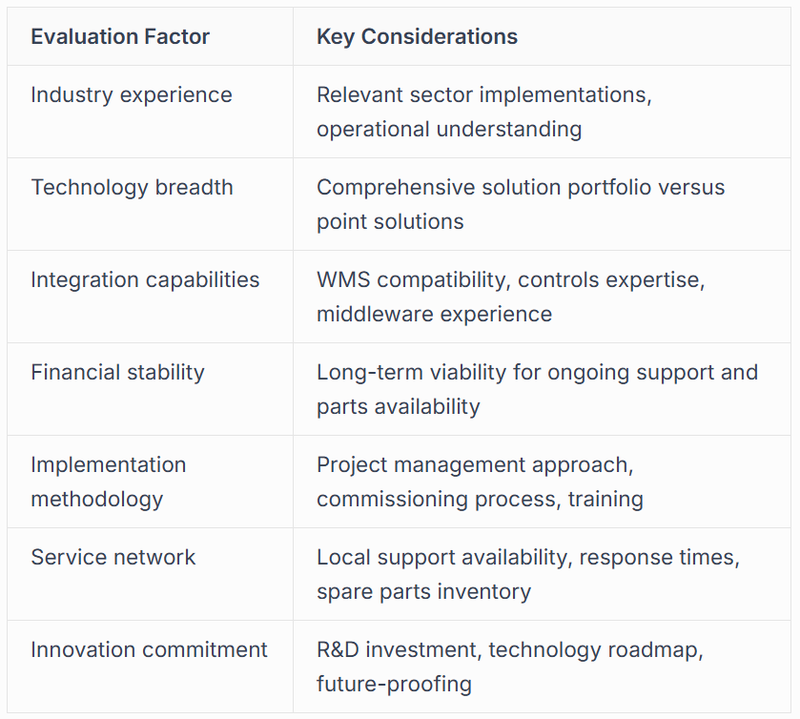
Reference site visits provide valuable insights into real-world performance, operational realities, and user experiences. Discussions with existing customers reveal partner responsiveness, problem-solving approaches, and post-implementation support quality.
Phased Implementation Strategies
Large-scale automation projects carry inherent risks. Phased approaches mitigate these risks by proving technologies in controlled environments before full-scale deployment.
Initial phases might automate fast-moving SKUs representing 20-30% of inventory but 60-70% of orders. This approach delivers meaningful benefits whilst maintaining manual fallback options for slower-moving products. Subsequent phases expand automation coverage as operational confidence grows and ROI validates initial assumptions.
Pilot implementations also provide workforce familiarisation opportunities. Operators gain experience with new technologies in lower-pressure environments, building competency before peak operating periods. This measured approach supports change management whilst reducing implementation risks.
Fulfillment center automation represents a strategic imperative for logistics operations facing escalating consumer expectations, labour challenges, and competitive pressures. The technologies, benefits, and implementation approaches examined throughout this guide demonstrate automation's transformative potential across diverse operational environments. Whether you're managing e-commerce fulfillment, 3PL operations, or sector-specific distribution, Automate-X combines modern robotics, intelligent software, and proven integration expertise to deliver automation solutions that streamline operations, improve productivity, and enable scalable growth for your business.