

Increasing Automation in Modern Warehouse Operations
Share on
Warehouse operations face unprecedented pressure in 2026. Customer expectations for rapid fulfilment, labour shortages, and razor-thin margins demand operational excellence. Traditional manual processes simply cannot keep pace with modern demand patterns. Increasing automation has emerged as the strategic imperative for logistics businesses seeking sustainable competitive advantage. From autonomous mobile robots to sophisticated warehouse management systems, automation technologies are fundamentally reshaping how distribution centres operate, enabling businesses to achieve levels of efficiency and accuracy that manual operations cannot match.
The Business Case for Warehouse Automation
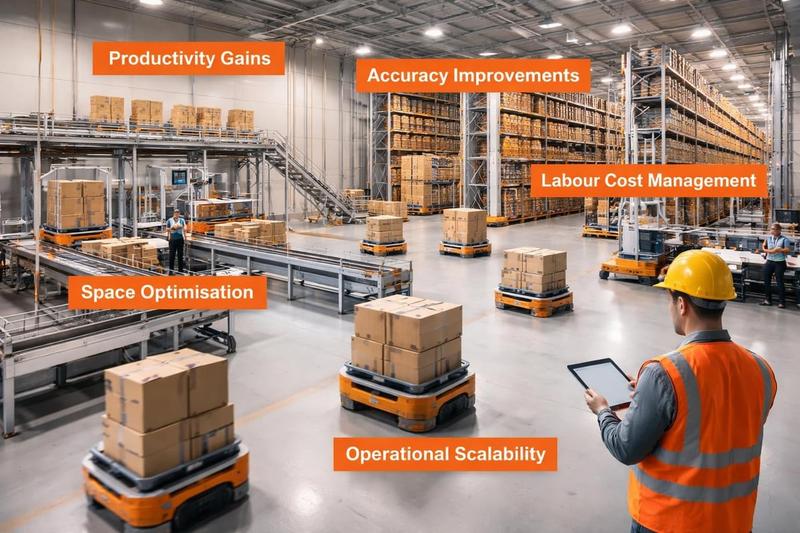
The financial justification for increasing automation extends far beyond simple labour cost reduction. Modern warehouse automation delivers measurable improvements across multiple operational dimensions that directly impact profitability and growth potential.
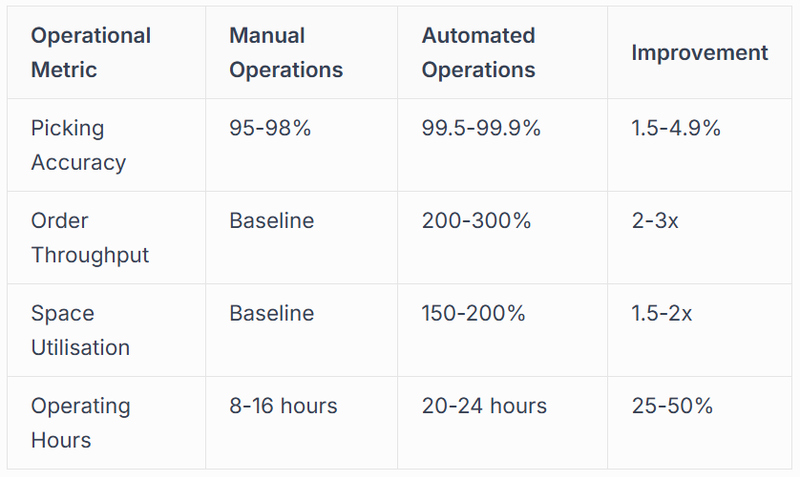
Productivity gains represent the most immediate benefit. Automated systems operate continuously without fatigue, achieving throughput rates that exceed manual operations by 200-300% in many applications. This capacity expansion allows businesses to handle growing order volumes within existing footprints.
Accuracy improvements eliminate costly errors. Automated picking systems routinely achieve 99.9% accuracy rates compared to 95-98% for manual operations. Each error prevented saves the expense of returns processing, customer service intervention, and brand reputation damage.
Space utilisation transforms when automation removes human access requirements. Shelf-to-person systems enable vertical storage densities impossible with traditional racking, often doubling effective storage capacity.
Labour availability challenges further strengthen the automation business case. Research shows that automation's impact on employment creates complex workforce dynamics, but for warehouse operators, automation solves critical staffing shortages while elevating remaining staff to higher-value supervisory and technical roles.
Strategic Approaches to Automation Implementation
Successful automation initiatives require strategic planning rather than tactical technology purchases. The most effective warehouse automation programmes follow structured implementation frameworks that align technology investment with business objectives.
Phased Implementation Strategy
Starting with high-impact processes delivers quick wins that build organisational confidence and fund subsequent phases. Many operations begin by automating their fastest-moving SKUs or most labour-intensive processes, achieving rapid payback that justifies broader automation investment.
Phase One priorities typically include:
- Automated storage and retrieval for high-velocity items
- Conveyor systems for inter-zone transfers
- Barcode scanning and verification systems
- Basic warehouse management system integration
Phase Two expansion builds on initial success:
- Autonomous mobile robots for goods movement
- Pick-to-light or voice-directed picking systems
- Automated sortation for order consolidation
- Advanced analytics and performance dashboards
Phase Three optimisation creates fully integrated operations:
- Robotic picking systems for complex SKU profiles
- Automated packaging and labelling
- Predictive maintenance systems
- AI-driven inventory positioning
The increasing automation journey need not require massive capital outlay. Solutions like the Automate-X GTP Starter Grid provide accessible entry points for small and medium operations to begin automating picking processes without the investment scale traditionally associated with warehouse automation.
Integration Planning Essentials
Technology integration determines automation success or failure. Warehouse automation systems must communicate seamlessly with enterprise resource planning systems, transportation management platforms, and customer order management systems.
Critical integration considerations include:
- Data architecture alignment ensuring consistent product identifiers, location codes, and transaction formats across systems
- Real-time synchronisation maintaining inventory accuracy as automated systems move goods
- Exception handling protocols defining automated and manual intervention rules for non-standard situations
- Performance monitoring establishing metrics and dashboards that provide operational visibility
Modern automation platforms use open APIs and standard communication protocols that simplify integration compared to legacy systems, but thorough planning remains essential to avoid costly retrofitting.
Technology Selection and System Design
Choosing appropriate automation technologies requires matching capabilities to operational requirements rather than pursuing the latest innovations. The most sophisticated technology rarely proves optimal if it exceeds actual business needs or cannot integrate with existing operations.
Automation Technology Categories
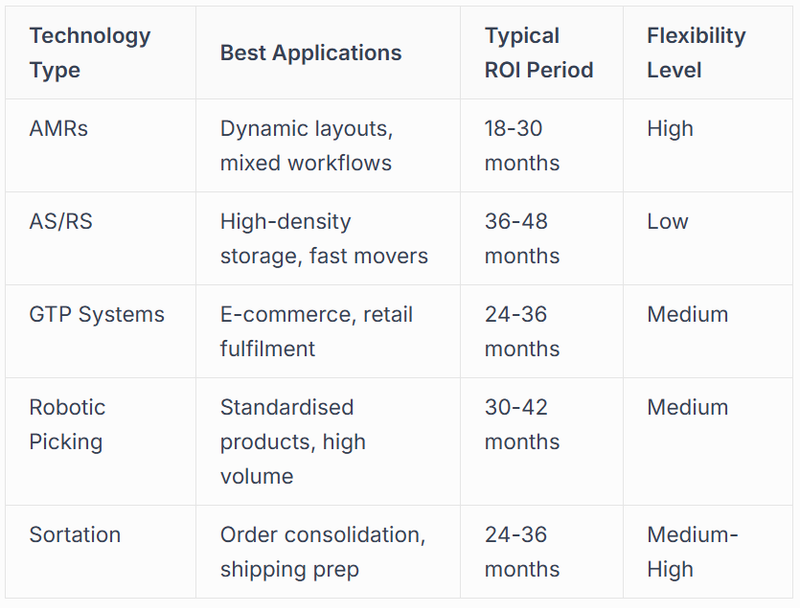
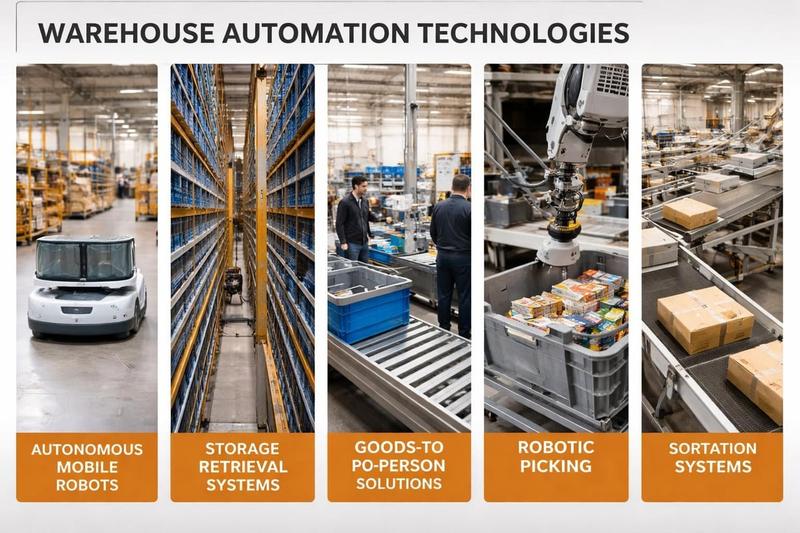
Autonomous Mobile Robots (AMRs) excel in dynamic environments where pick faces change frequently or workflows require flexibility. These intelligent systems navigate independently, transport materials between zones, and adapt to operational changes without fixed infrastructure modification.
Automated Storage and Retrieval Systems (AS/RS) optimise space utilisation and throughput for high-density storage applications. These systems use computer-controlled mechanisms to automatically place and retrieve loads from designated storage locations.
Goods-to-Person (GTP) systems bring products to stationary picking operators, eliminating travel time that consumes 50-60% of manual picking labour. These systems particularly suit high-throughput e-commerce and retail fulfilment operations.
Robotic picking systems handle the physical manipulation of individual items, addressing the last major manual bottleneck in warehouse operations. While still evolving for complex SKU profiles, these systems already deliver value for standardised products.
Automated sortation systems consolidate picked items into customer orders, enabling efficient wave picking strategies that multiply productivity versus discrete order picking.
Analysis from experts examining how automation reshapes work emphasises that successful technology selection balances economic efficiency with workforce transition management, ensuring automation enhances rather than disrupts operational capability.
Safety and Compliance Considerations
Increasing automation introduces new safety requirements as humans and machines share operational space. Machine safety systems incorporate sensors, barriers, and protocols that protect personnel while maintaining system productivity.
Safety zone design establishes physical and electronic boundaries that prevent dangerous interactions. Light curtains, pressure-sensitive mats, and emergency stop systems create multiple protection layers.
Regulatory compliance varies by jurisdiction and industry. Pharmaceutical and food operations face particularly stringent requirements around contamination prevention, traceability, and audit trails that automation systems must support.
Training programmes ensure personnel understand automated system operation, safety protocols, and emergency procedures. The workforce transition from manual to automated operations requires structured change management.
Operational Transformation Through Automation
Beyond productivity metrics, increasing automation fundamentally transforms warehouse management approaches, enabling operational strategies impossible with manual processes.
Dynamic Inventory Positioning
Automated systems enable sophisticated slotting strategies that continuously optimise product placement based on demand patterns. Fast-moving items automatically migrate to accessible locations while slow movers shift to higher-density storage, maximising both throughput and space efficiency.
Traditional manual warehouses update slotting quarterly or annually due to labour requirements. Automated systems adjust daily or even hourly, responding to real-time demand signals.
Extended Operating Windows
Automation removes the constraint of human fatigue and shift patterns. Many automated warehouses operate 20-24 hours daily, processing orders overnight for morning dispatch or supporting global fulfilment networks across time zones.
This extended capacity provides competitive advantages in customer service while smoothing peak-period stress. Rather than scrambling to hire seasonal labour, automated operations simply extend runtime during demand surges.
Predictive Maintenance and Performance Optimisation
Modern automation systems generate continuous operational data that enables predictive maintenance and performance optimisation. Sensor networks detect developing issues before failures occur, shifting maintenance from reactive emergency repairs to scheduled interventions during low-volume periods.
Performance analytics identify efficiency opportunities across multiple dimensions:
- Equipment utilisation rates revealing capacity bottlenecks
- Cycle time analysis highlighting process improvement opportunities
- Energy consumption patterns enabling sustainability initiatives
- Throughput trends supporting capacity planning decisions
Insights about agentic AI's role in intelligent work suggest that future warehouse automation will incorporate autonomous decision-making systems that continuously optimise operations without human intervention, representing the next evolution beyond current programmable automation.
Workforce Evolution in Automated Environments
The transformation to automated operations reshapes workforce requirements rather than simply reducing headcount. Successful warehouse automation programmes invest in workforce development that enables employees to transition into higher-value roles.
Technical positions expand as automated systems require maintenance technicians, system administrators, and integration specialists. These roles command higher wages than manual picking positions while offering greater career development opportunities.
Supervisory roles evolve from directing manual labour to managing system performance, resolving exceptions, and optimising automated operations. These positions demand analytical skills and technology proficiency rather than physical stamina.
Quality and compliance functions grow in importance as automated systems handle routine transactions, freeing personnel to focus on verification, auditing, and continuous improvement initiatives that manual operations never had capacity to prioritise.
Recent polling data reveals growing workplace divisions regarding AI adoption, highlighting the importance of change management and employee engagement during automation transitions.
Training and Development Programmes
Effective workforce transition requires structured training that builds technical competency and operational understanding. Leading warehouse automation initiatives include:
- System operation training covering standard procedures, troubleshooting basics, and emergency protocols
- Technical certification programmes developing maintenance and engineering capabilities within existing workforce
- Process optimisation workshops teaching analytical methods and continuous improvement techniques
- Leadership development preparing supervisors for technology-enabled management approaches
Investment in workforce development delivers double benefits, both enabling successful automation adoption and improving employee retention during operational transitions.
Measuring Automation Success
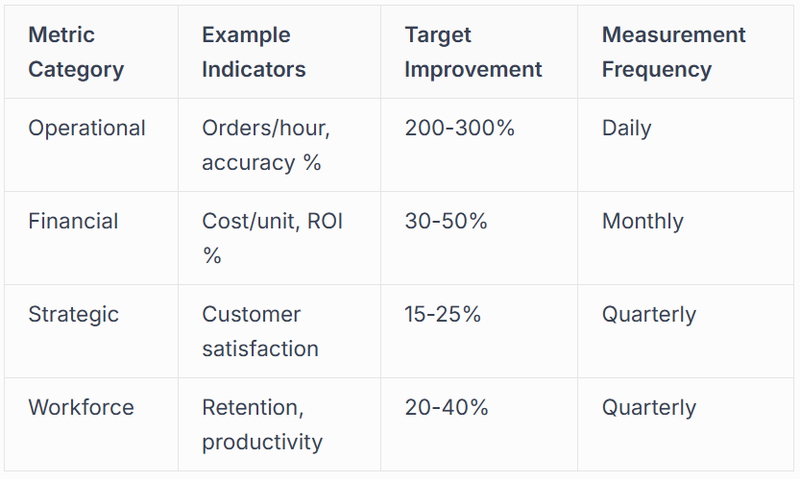
Establishing appropriate performance metrics ensures automation investments deliver projected returns and identifies optimisation opportunities. Effective measurement frameworks balance operational efficiency, financial performance, and strategic capability development.
Key Performance Indicators
Operational metrics track immediate system performance:
- Orders per hour measuring throughput capacity
- Pick accuracy rates quantifying quality performance
- Cycle time analysis identifying bottlenecks
- Equipment utilisation revealing capacity efficiency
- Error rates highlighting process improvement needs
Financial metrics validate investment returns:
- Labour cost per unit shipped
- Operating cost per square metre
- Return on automation investment
- Working capital requirements
- Total cost of ownership calculations
Strategic metrics assess long-term competitive positioning:
- Order fulfilment speed compared to market standards
- Capacity scalability supporting growth plans
- Customer satisfaction and Net Promoter Scores
- Employee retention and advancement rates
- Sustainability metrics including energy efficiency
Experts examining AI predictions for 2025 note that intelligent systems increasingly incorporate self-optimisation capabilities, suggesting future automation performance measurement may shift from operator-driven analysis to AI-recommended improvements.
Future Directions in Warehouse Automation
The warehouse automation landscape continues rapid evolution, with emerging technologies promising further operational transformation. Understanding these trends helps businesses plan automation roadmaps that remain relevant as capabilities advance.
Artificial intelligence integration moves automation beyond programmed responses to adaptive learning systems that optimise operations based on pattern recognition. AI-powered systems predict demand fluctuations, identify efficiency opportunities, and recommend operational adjustments without human programming.
Collaborative robotics enables safer human-machine interaction through advanced sensors and force-limiting mechanisms. These systems work alongside personnel rather than in segregated zones, combining automation efficiency with human problem-solving flexibility.
Digital twin technology creates virtual replicas of physical warehouse operations, enabling simulation testing of process changes, capacity planning scenarios, and system optimisation experiments without operational disruption.
Sustainability features incorporate energy optimisation, renewable power integration, and circular economy principles as warehouse automation increasingly addresses environmental performance alongside operational efficiency.
The pace of innovation in warehouse automation technologies means that systems designed with modularity and upgrade pathways maintain relevance longer than monolithic installations that cannot accommodate emerging capabilities.
Increasing automation represents a strategic imperative for warehouse operations facing margin pressure, labour challenges, and rising customer expectations. Successful automation programmes balance technology capability with business requirements, workforce development, and operational integration. Automate-X combines modern robotics, intelligent software, and system integration expertise to help logistics and supply chain businesses transform warehouse operations, improve productivity, and build scalable growth foundations across distribution and fulfilment environments.