

Manufacturing Automation System: Complete Guide 2026
Share on
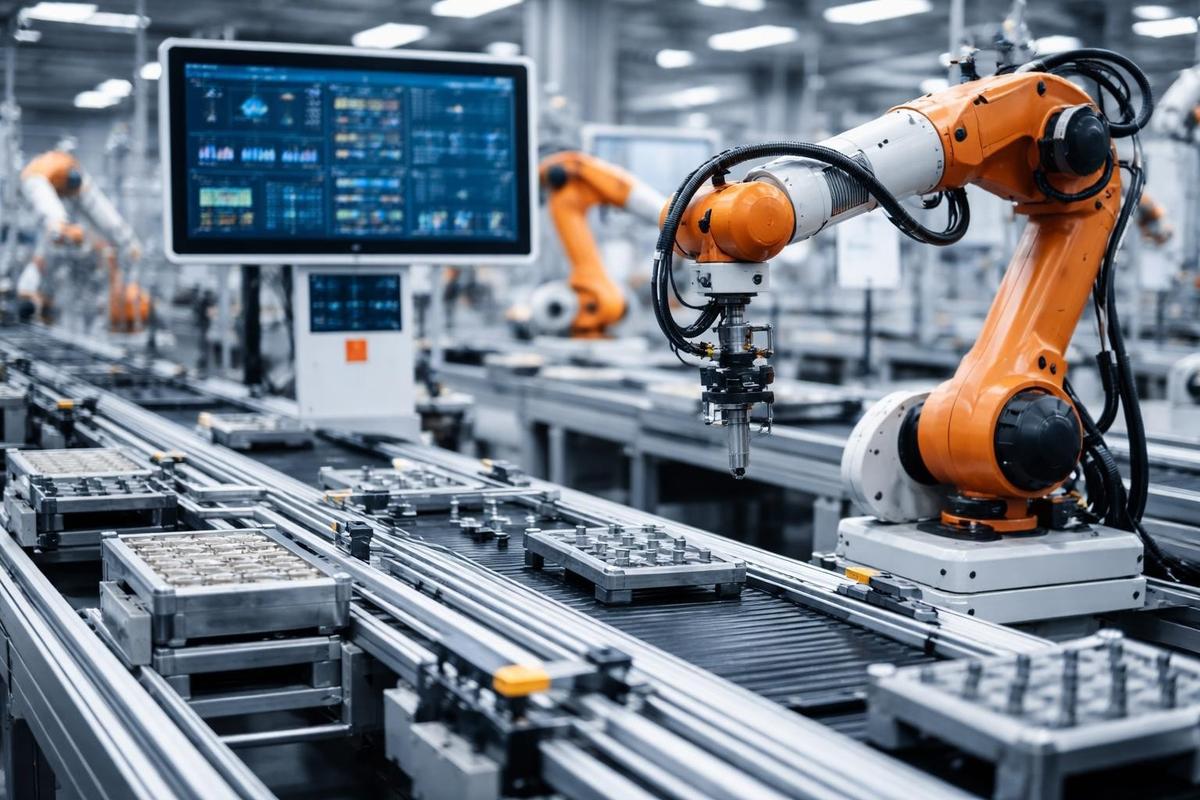
Modern production environments face mounting pressure to deliver higher output with greater accuracy while controlling operational costs. A manufacturing automation system represents the convergence of robotics, software intelligence, and mechanical systems designed to execute production tasks with minimal human intervention. These sophisticated frameworks transform traditional manufacturing floors into responsive, data-driven operations that adapt to demand fluctuations, quality requirements, and efficiency targets. As businesses across New Zealand and Australia seek competitive advantages, understanding how automation systems function and integrate within broader operational strategies becomes essential for sustainable growth.
Understanding Manufacturing Automation System Architecture
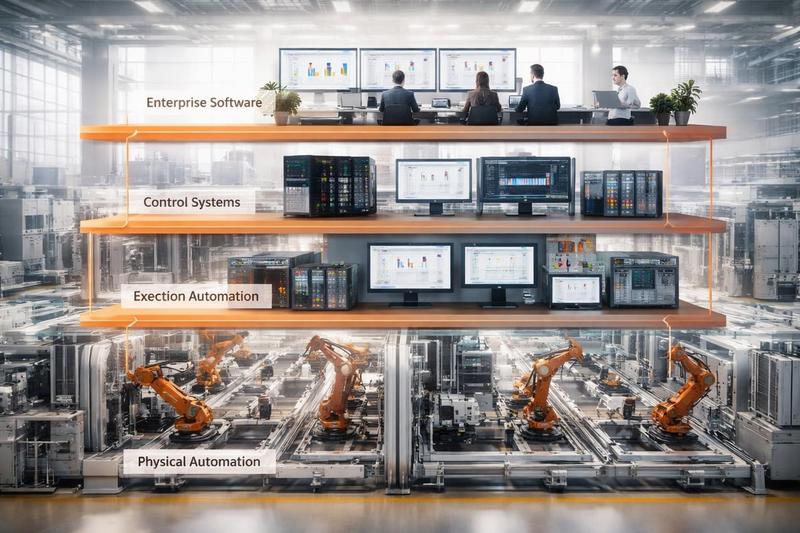
A manufacturing automation system comprises multiple interconnected layers that work in harmony to control production processes. At the foundation sits the physical automation layer, including robotics, conveyors, automated guided vehicles, and material handling equipment. These components execute the tangible work of moving, assembling, sorting, and packaging products.
The control layer manages these physical assets through programmable logic controllers (PLCs), distributed control systems, and motion controllers. This tier translates high-level instructions into precise mechanical actions, coordinating timing, speed, and positioning across multiple devices simultaneously.
Above the control layer, the supervisory level hosts human-machine interfaces (HMIs) and manufacturing execution systems that bridge the gap between shop floor equipment and enterprise planning systems. This integration enables real-time visibility into production status, quality metrics, and resource utilisation.
Key Components and Their Functions
Understanding the distinct elements within a manufacturing automation system helps organisations identify specific improvement opportunities:
- Sensors and vision systems: Capture real-time data about product position, quality attributes, and environmental conditions
- Actuators and robotics: Execute physical movements with precision and repeatability
- Communication networks: Enable data exchange between devices, controllers, and management systems
- Software platforms: Process information, make decisions, and coordinate workflows across the production environment
- Safety systems: Monitor operations continuously to protect personnel and prevent equipment damage
Each component must integrate seamlessly with others to achieve the responsiveness and reliability that modern production demands. The critical role of integration in factory automation cannot be overstated, as isolated systems create bottlenecks and limit overall performance gains.
Automation Levels in Manufacturing Operations
Not all manufacturing automation systems achieve the same degree of autonomy. Understanding the spectrum of automation helps organisations set realistic expectations and plan implementation strategies appropriate to their operational maturity.
From Manual to Fully Autonomous
The progression towards high-automation manufacturing typically follows these stages:
- Manual operations: Human workers perform all tasks with basic hand tools
- Mechanised processes: Powered equipment assists workers but requires direct human control
- Automated individual processes: Specific tasks run independently with programmed sequences
- Integrated automation: Multiple processes coordinate through centralised control systems
- Intelligent automation: Systems adapt to variables, optimise performance, and self-correct
- Autonomous operations: Facilities operate with minimal human intervention, self-managing production
Most organisations occupy the middle stages, where they've automated specific high-volume or hazardous tasks while maintaining human oversight for complex decision-making. The manufacturing automation system design reflects strategic priorities, balancing investment against expected returns in productivity, quality, and flexibility.
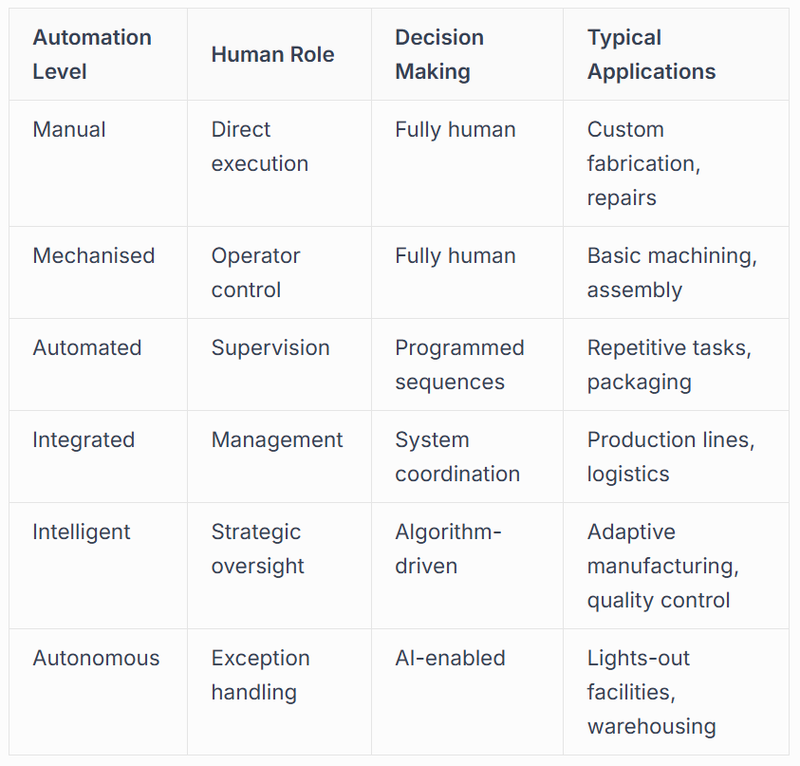
This progression isn't necessarily linear. Organisations often implement advanced automation in specific areas while maintaining manual processes elsewhere, creating hybrid environments that leverage automation where it delivers maximum value.
Strategic Benefits Driving Adoption
The decision to implement a manufacturing automation system stems from concrete operational challenges that manual processes cannot adequately address. Understanding these drivers helps organisations prioritise automation initiatives and measure success effectively.
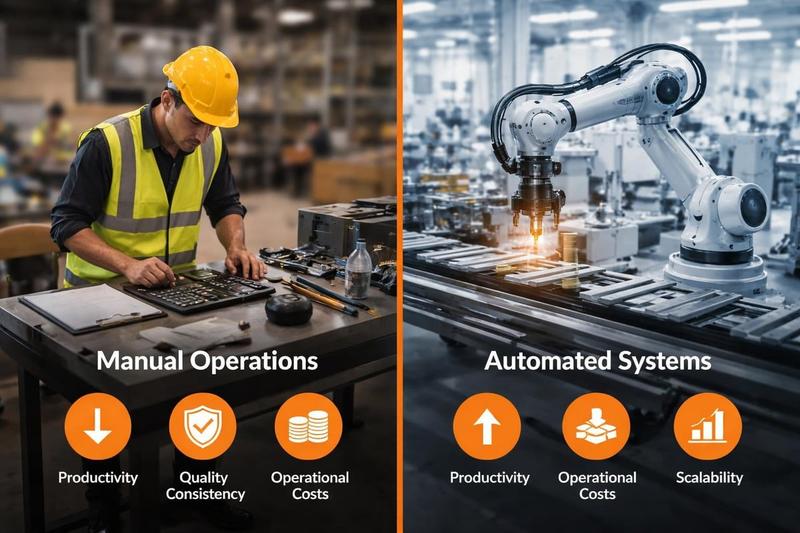
Productivity enhancement stands as the most visible benefit. Automated systems operate continuously without fatigue, maintaining consistent throughput rates that exceed human capabilities. This reliability enables organisations to meet demanding delivery schedules and handle volume spikes without proportional labour increases.
Quality consistency represents another compelling advantage. A properly configured manufacturing automation system executes tasks with repeatable precision, reducing variation in product specifications. This consistency minimises rework, scrap, and warranty claims while strengthening brand reputation.
Operational and Financial Advantages
Beyond immediate productivity gains, automation delivers strategic benefits that compound over time:
- Labour optimisation: Redeploy workers from repetitive tasks to value-adding activities requiring human judgment
- Space efficiency: Compact automated systems often require less floor space than manual workstations
- Data generation: Continuous monitoring creates rich datasets for process improvement and predictive maintenance
- Safety improvements: Remove personnel from hazardous environments and reduce workplace injuries
- Scalability: Increase capacity through software adjustments rather than physical expansion
According to comprehensive research on manufacturing automation, organisations implementing advanced systems report productivity improvements ranging from 25% to 40%, with quality defect reductions of 30% to 60% in many applications.
The financial case strengthens when considering long-term operational costs. While initial capital investment appears substantial, reduced labour costs, improved yield, and decreased waste typically generate positive returns within 18 to 36 months for well-planned implementations.
Integration with Warehouse and Logistics Systems
Manufacturing automation extends beyond the production floor, creating end-to-end efficiency when integrated with warehouse and distribution operations. This holistic approach eliminates handoff delays and optimises the entire value chain from raw materials to customer delivery.
A manufacturing automation system generates finished goods that must move efficiently into storage, order fulfilment, and dispatch processes. Without integrated warehouse automation, production gains create bottlenecks in downstream operations. Forward-thinking organisations design their automation strategies to encompass the complete product journey.
Creating Seamless Material Flow
Modern warehouse automation solutions connect directly with manufacturing execution systems, enabling real-time visibility and coordination. When production completes a batch, the warehouse management system automatically receives inventory updates, triggers put-away processes, and updates available-to-promise calculations for customer orders.
This integration becomes particularly valuable for operations handling diverse product portfolios or customised manufacturing. The warehouse automation system can route different SKUs through appropriate storage zones, apply specific handling rules, and coordinate order assembly based on production schedules.
For businesses just beginning their automation journey, solutions like the Automate-X GTP Starter Grid provide an accessible entry point that demonstrates integration benefits without overwhelming existing operations. This modular approach allows organisations to validate automation concepts in controlled environments before expanding to full-scale implementations.
The synergy between manufacturing and warehouse automation creates compounding benefits. Production systems optimise batch sizes based on warehouse capacity constraints, while warehouse systems adjust labour scheduling and carrier appointments according to manufacturing output. This bidirectional coordination eliminates waste throughout the supply chain.
Technology Enablers in Modern Systems
The manufacturing automation system landscape has evolved dramatically with advances in computing power, sensor technology, and software capabilities. Contemporary implementations leverage technologies that were experimental just five years ago.
Artificial intelligence and machine learning now power adaptive systems that optimise parameters without explicit programming. These algorithms analyse historical performance data to predict optimal settings for new production runs, reducing setup time and accelerating time-to-quality.
Industrial Internet of Things (IIoT) connectivity creates comprehensive operational visibility. Every sensor, actuator, and controller generates data streams that feed analytics platforms, enabling predictive maintenance, quality trending, and real-time process adjustments.
Emerging Capabilities Reshaping Automation
Several technology trends are fundamentally changing what's possible with manufacturing automation:
- Digital twins: Virtual replicas of physical systems enable simulation, testing, and optimisation without disrupting production
- Collaborative robots: Safely work alongside humans, combining automation efficiency with human judgment and dexterity
- Edge computing: Process data locally for faster response times while reducing network bandwidth requirements
- Cloud integration: Connect distributed facilities, enable remote monitoring, and aggregate performance data across locations
- Augmented reality: Assist operators with maintenance procedures, training, and troubleshooting through visual overlays
Research published in standards and scenarios for smart manufacturing highlights how these technologies create more flexible, responsive automation frameworks that adapt to changing market demands and product variations.
The software layer has become as critical as mechanical components. Modern manufacturing automation systems rely on sophisticated platforms that orchestrate workflows, manage exceptions, and continuously optimise performance based on evolving constraints and objectives.
Implementation Considerations and Planning
Successful manufacturing automation system deployment requires thorough planning that addresses technical, organisational, and financial dimensions. Rushed implementations frequently deliver disappointing results, while methodical approaches that engage stakeholders across functions create sustainable value.
Assessment and Design Phase
Begin by documenting current state processes with quantitative metrics: cycle times, quality rates, labour hours, and throughput volumes. This baseline enables accurate ROI calculations and provides benchmarks for measuring improvement.
Identify specific pain points and opportunities where automation delivers maximum impact. Focus initial efforts on processes that are:
- High volume and repetitive
- Requiring consistent precision
- Physically demanding or hazardous
- Creating quality bottlenecks
- Limiting overall throughput
Map dependencies between processes to understand how automating one area affects upstream and downstream operations. Isolated automation of a single process may simply shift bottlenecks elsewhere rather than improving overall performance.
Develop detailed specifications for the manufacturing automation system, including:
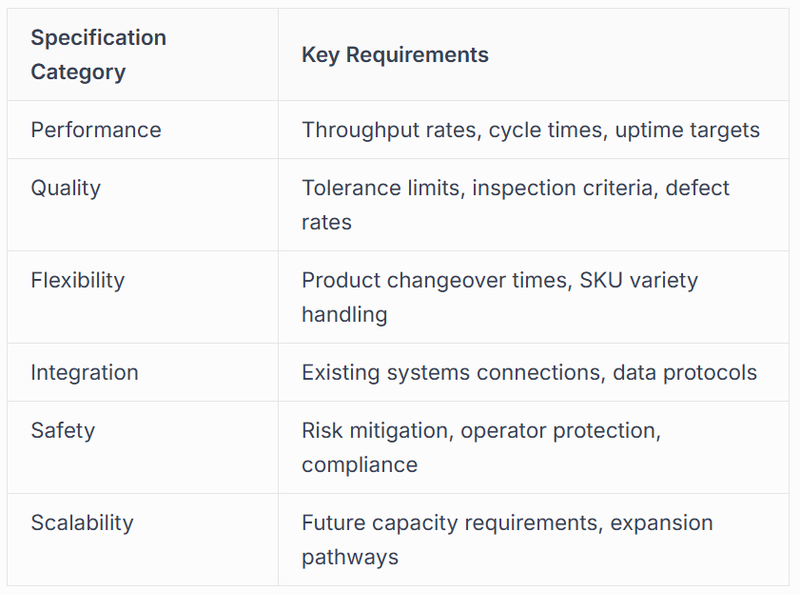
Engage potential system integrators early in the design process. Their experience with similar applications provides valuable insights that prevent costly mistakes and optimise system architecture.
Workforce Transformation and Change Management
Introducing a manufacturing automation system fundamentally changes how people work. Successful implementations address the human dimensions with the same rigour applied to technical design.
Transparent communication about automation objectives prevents anxiety and resistance. Clearly articulate that automation aims to eliminate dangerous, tedious tasks while creating opportunities for workers to develop new skills in system operation, maintenance, and optimisation.
Building Automation Competency
Develop comprehensive training programmes that prepare workers for new roles before systems go live. Effective training includes:
- Technical operation: How to monitor, control, and interact with automated equipment
- Problem solving: Diagnosing common issues and implementing corrective actions
- Safety protocols: Proper procedures for working around automated systems
- Data interpretation: Understanding performance metrics and identifying improvement opportunities
Partner with equipment suppliers and system integrators to deliver hands-on training using actual hardware. Classroom instruction alone cannot prepare operators for the realities of managing complex automation.
Create career pathways that recognise the increased skill requirements for automation roles. Workers who successfully transition from manual operations to system specialists deserve compensation reflecting their enhanced value to the organisation.
Case studies from operations like the DHL's automated warehouse in Auckland demonstrate how thoughtful workforce planning creates enthusiastic adoption rather than resistance. When employees see tangible benefits in their working conditions and career prospects, they become automation advocates.
Performance Measurement and Continuous Improvement
Installing a manufacturing automation system represents the beginning rather than the end of the transformation journey. Realising full value requires ongoing monitoring, analysis, and refinement of system performance.
Establish key performance indicators (KPIs) that reflect strategic automation objectives:
- Overall Equipment Effectiveness (OEE): Comprehensive metric combining availability, performance, and quality
- Throughput per labour hour: Measures productivity gains from automation investment
- First pass yield: Tracks quality improvements through reduced defects
- Mean time between failures (MTBF): Indicates system reliability and maintenance effectiveness
- Changeover time: Monitors flexibility and responsiveness to product variations
Track these metrics continuously through the manufacturing automation system's data collection capabilities. Modern systems generate rich datasets that reveal optimisation opportunities invisible to manual observation.
Optimisation Strategies
Regular performance reviews identify specific improvement areas. Common optimisation targets include:
- Reducing cycle time variability: Minimises buffer inventory and improves planning accuracy
- Eliminating micro-stoppages: Small interruptions compound into significant throughput losses
- Balancing line speeds: Ensures no single process creates systemic bottlenecks
- Refining quality parameters: Tightens specifications without increasing false rejects
- Predictive maintenance scheduling: Prevents failures while avoiding unnecessary interventions
Implement structured problem-solving methodologies like Six Sigma or lean manufacturing principles to drive continuous improvement. The data generated by automated systems provides the factual foundation these approaches require.
Benchmark performance against industry standards and best-in-class operations. While every facility has unique characteristics, comparative analysis identifies gaps and sets realistic improvement targets. Resources like examples from successful warehouse automation implementations provide valuable reference points.
Integration Challenges and Solutions
Despite compelling benefits, manufacturing automation system implementations encounter predictable obstacles that organisations must anticipate and address proactively.
Legacy system compatibility frequently complicates integration efforts. Older equipment may lack modern communication protocols or data interfaces, requiring costly middleware solutions or hardware upgrades. Conduct thorough technical assessments during planning to identify compatibility issues before committing to specific automation approaches.
Change resistance from operators and supervisors can undermine even technically sound implementations. Address this through early involvement of floor personnel in design decisions, transparent communication about objectives, and genuine commitment to workforce development rather than reduction.
Technical and Organisational Obstacles
Additional challenges requiring attention include:
- Data standardisation: Inconsistent formats across systems prevent effective integration and analytics
- Cybersecurity concerns: Connected equipment creates potential vulnerabilities requiring robust protection
- Vendor lock-in: Proprietary systems limit future flexibility and create dependency on single suppliers
- Scalability constraints: Systems designed for current capacity may not accommodate future growth
- Maintenance complexity: Sophisticated automation requires specialised knowledge and spare parts management
Mitigate these risks through careful vendor selection, insisting on open standards and documented interfaces, and developing in-house technical expertise rather than complete dependence on external support.
The research on process automation systems emphasises the importance of modular, standards-based architectures that enable incremental evolution rather than forced wholesale replacements as technology advances.
Future Directions in Manufacturing Automation
The manufacturing automation system landscape continues evolving rapidly, with several emerging trends shaping next-generation capabilities and applications.
Autonomous mobile robots (AMRs) are replacing fixed conveyor systems in many applications, providing greater flexibility to reconfigure material flow as production requirements change. These intelligent vehicles navigate dynamically, avoiding obstacles and optimising routes without pre-defined paths.
Additive manufacturing integration enables on-demand production of custom components and tools, reducing inventory requirements and enabling mass customisation. Manufacturing automation systems increasingly incorporate 3D printing cells alongside traditional subtractive processes.
Sustainable automation addresses environmental concerns through energy optimisation, waste reduction, and circular economy principles. Next-generation systems incorporate sustainability metrics alongside traditional productivity and quality measures.
Advanced analytics and AI continue expanding the scope of automated decision-making. Systems that once required human intervention for exceptions increasingly handle variations autonomously, escalating only truly novel situations that fall outside learned parameters.
The convergence of manufacturing and logistics automation creates unified material flow networks that optimise the complete value chain. Products move seamlessly from raw materials through production, warehousing, and distribution without handoffs or delays.
As these technologies mature, the competitive advantage shifts from simply having automation to how effectively organisations leverage data and intelligence embedded within their systems. The manufacturing automation system becomes a strategic asset that continuously learns, adapts, and improves performance without constant manual intervention.
Manufacturing automation systems deliver transformative benefits when implemented strategically with attention to technical integration, workforce development, and continuous improvement. These sophisticated frameworks enable the productivity, quality, and flexibility modern markets demand. Automate-X combines advanced robotics, intelligent software, and proven integration expertise to help logistics and supply chain businesses build comprehensive automation solutions tailored to their operational requirements. Contact our team to explore how intelligent automation can accelerate your growth while improving efficiency across your warehouse and distribution operations.