

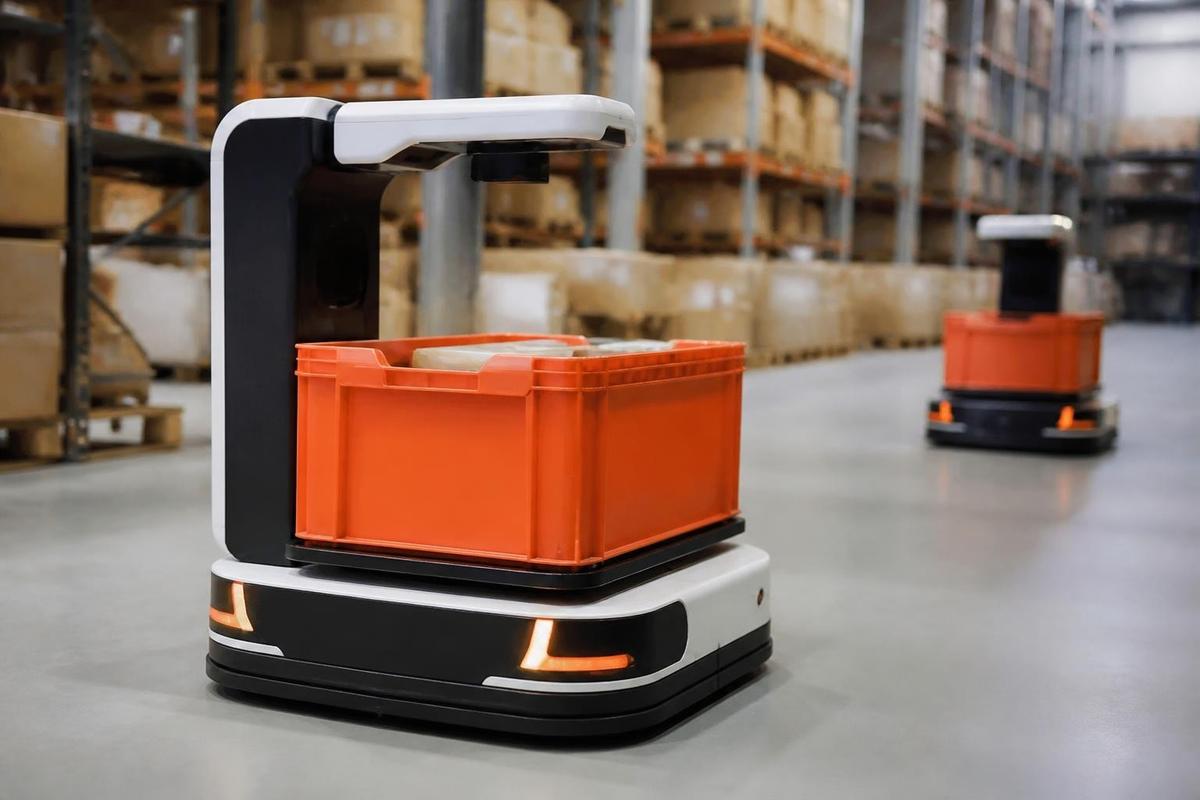
Warehouse Picking Robots: The Future of Fulfilment
Share on
The logistics industry stands at a pivotal moment where labour shortages, rising customer expectations, and the demand for faster fulfilment cycles converge. Warehouse picking robots have emerged as a transformative solution, fundamentally reshaping how distribution centres, 3PLs, and e-commerce fulfilment operations handle order picking. These intelligent systems combine robotics, machine vision, and sophisticated software to automate what has traditionally been one of the most labour-intensive aspects of warehouse operations. As we progress through 2026, the adoption of automated picking solutions has accelerated beyond early adopter phase into mainstream implementation across diverse sectors including pharmaceuticals, FMCG, and cold storage.
Understanding Warehouse Picking Robot Technologies
Modern warehouse picking robots encompass several distinct technologies, each designed to address specific operational challenges and facility layouts. The landscape includes autonomous mobile robots (AMRs), articulated robotic arms, collaborative robots (cobots), and integrated goods-to-person systems.
Autonomous Mobile Robots for Picking
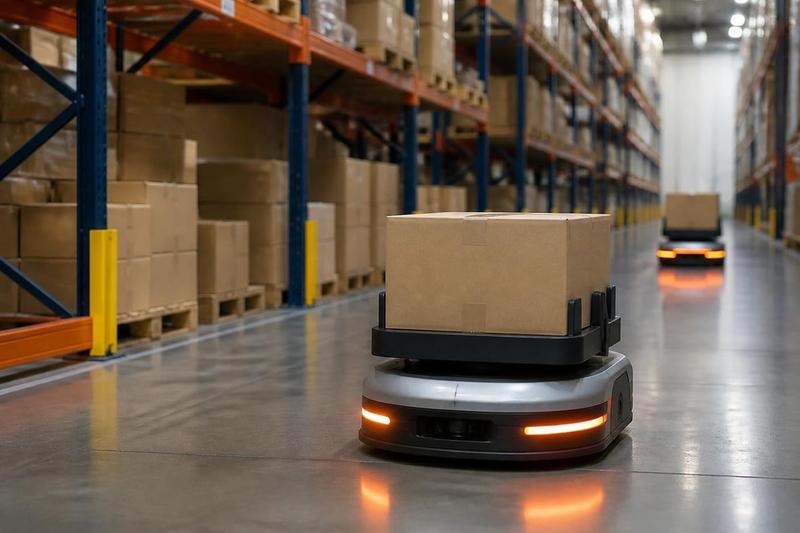
AMRs represent a flexible approach to warehouse automation. These robots navigate independently through warehouse aisles using sensors, cameras, and sophisticated algorithms. Unlike their predecessors, guided vehicles (AGVs), warehouse AMRs can adapt to changing floor plans and avoid obstacles dynamically.
Key capabilities include:
- Dynamic path planning and obstacle avoidance
- Integration with warehouse management systems (WMS)
- Collaborative operation alongside human workers
- Scalable deployment without major infrastructure changes
- Real-time inventory tracking and location updates
The versatility of AMRs makes them particularly suitable for operations experiencing seasonal fluctuation or frequent layout modifications. Their ability to work collaboratively with human pickers creates hybrid workflows that maximise both efficiency and accuracy.
Robotic Arm Systems and Piece Picking
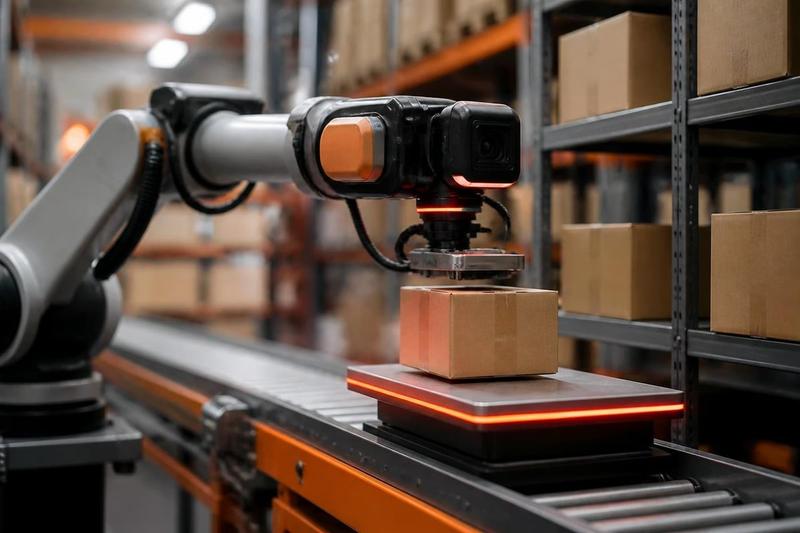
Articulated robotic arms excel at piece-picking applications where precision and repeatability matter most. These systems employ advanced machine vision and grasp-planning algorithms to identify, grasp, and place individual items. Recent developments in optimised grasp pose detection using RGB images have significantly improved picking success rates across varied product types.
Modern robotic arms incorporate:
- Multi-axis articulation for complex movements
- Vision systems with depth perception and object recognition
- Adaptive grippers handling diverse product geometries
- Learning algorithms that improve over time
- Integration with conveyor systems and storage arrays
The pharmaceutical and electronics sectors particularly benefit from robotic arm precision, where product handling requirements demand consistency and gentle manipulation to prevent damage.
Implementation Strategies for Warehouse Picking Robots
Successfully deploying warehouse picking robots requires methodical planning, stakeholder alignment, and phased execution. The implementation journey differs significantly from traditional warehouse equipment installations due to software integration complexity and workflow redesign requirements.
Assessing Operational Readiness
Before committing to robotic picking systems, organisations must evaluate their current operations against readiness criteria. This assessment identifies gaps and establishes realistic timelines.
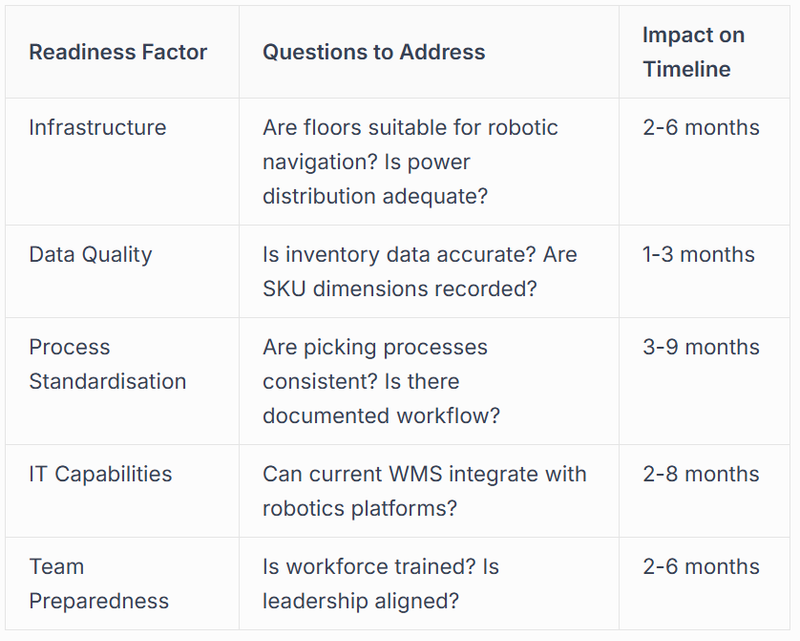
Operations with high SKU variety, consistent order volumes, and standardised processes typically achieve faster implementation. Conversely, facilities with irregular product dimensions or highly seasonal demand patterns require more extensive planning.
Integration with Existing Systems
The software layer proves as critical as the physical robots themselves. Warehouse picking robots must exchange data seamlessly with WMS, enterprise resource planning (ERP) systems, and order management platforms.
Integration encompasses several technical dimensions:
- Real-time data synchronisation between robotics control systems and warehouse management platforms
- Order allocation logic that optimises task distribution between human and robotic workers
- Inventory accuracy mechanisms leveraging robotic sensors for cycle counting
- Performance monitoring dashboards providing operational visibility
- Exception handling protocols for items robots cannot process
Many organisations underestimate integration complexity, leading to extended timelines and budget overruns. Partnering with experienced automation providers who understand both robotics and warehouse software architectures mitigates this risk substantially. For operations seeking a streamlined entry point, the Automate-X GTP Starter Grid provides an integrated solution designed specifically for small to medium enterprises beginning their automation journey.
Operational Benefits and Performance Metrics
Warehouse picking robots deliver measurable improvements across multiple performance dimensions. Understanding these benefits helps justify investment and set appropriate expectations for stakeholders.
Productivity and Throughput Gains
Robotic picking systems typically increase picking throughput by 100-300% compared to manual operations, depending on order profiles and implementation quality. Unlike human workers, robots maintain consistent performance throughout shifts without fatigue-related slowdowns.
Measured productivity improvements include:
- Picks per hour increasing from 60-80 (manual) to 200-400 (robotic)
- Order cycle time reduction of 40-70%
- Elimination of walking time in large facilities
- Extended operational hours without overtime costs
- Peak season capacity without temporary labour
The transformation of warehouse operations through autonomous systems extends beyond simple speed improvements. These systems enable entirely new operational models where fulfilment happens continuously rather than in discrete shifts.
Accuracy and Quality Improvements
Picking errors represent a significant cost driver in warehouse operations. Warehouse picking robots equipped with vision systems and weight verification achieve accuracy rates exceeding 99.9%, compared to 98-99% for manual picking.
Error reduction translates into:
- Decreased returns processing costs
- Improved customer satisfaction scores
- Reduced labour spent on exception handling
- Lower inventory shrinkage
- Enhanced brand reputation through accurate fulfilment
Technology Trends Shaping 2026 and Beyond
The warehouse picking robot market continues evolving rapidly, with several technological advances becoming mainstream in 2026. According to recent analysis, robots will handle the majority of workloads in new warehouses by 2030, making current investments foundational for long-term competitiveness.
Artificial Intelligence and Machine Learning
AI capabilities embedded in warehouse picking robots enable continuous improvement without human programming intervention. Machine learning algorithms analyse millions of picking operations to optimise grasp strategies, path planning, and task prioritisation.
Contemporary AI applications include:
- Predictive maintenance reducing unplanned downtime by 30-50%
- Dynamic task allocation based on real-time conditions
- Object recognition handling previously unseen products
- Collaborative learning across robot fleets
- Demand forecasting integration for proactive positioning
Research into segmentation and tracking of unseen objects addresses one of the persistent challenges in warehouse robotics: handling new products without extensive training periods.
Interoperability and Fleet Management
Modern warehouses increasingly deploy multi-vendor robot fleets, necessitating robust interoperability standards. The industry has progressed from proprietary, closed systems toward open architectures enabling mixed-vendor environments.
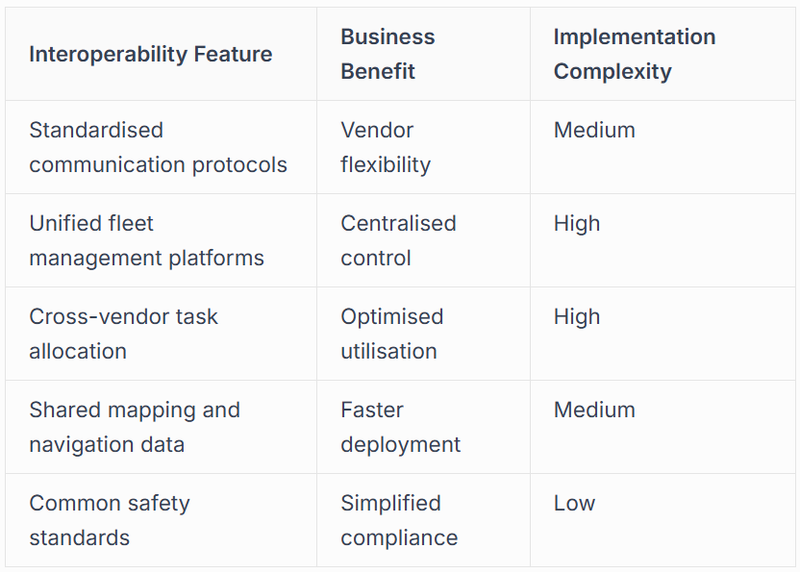
Experts suggest that organisations should prioritise flexibility and interoperability when selecting autonomous mobile robots to avoid vendor lock-in and enable future scalability.
Sector-Specific Applications and Considerations
Different industries present unique challenges and opportunities for warehouse picking robots. Understanding these sector-specific factors ensures appropriate technology selection and implementation approaches.
E-commerce and 3PL Operations
E-commerce fulfilment demands high-velocity picking across vast SKU ranges with order profiles characterised by small quantities and tight delivery windows. Warehouse picking robots excel in these environments by:
- Processing high volumes of single-item orders efficiently
- Adapting to daily SKU additions without reprogramming
- Supporting same-day and next-day delivery commitments
- Handling peak period surges without proportional labour increases
- Enabling distributed micro-fulfilment centre models
The competitive dynamics of e-commerce make automation adoption increasingly non-negotiable. Major players have expanded robotic deployments significantly, as evidenced by Amazon's continued warehouse robot expansion.
Pharmaceutical and Cold Storage
Regulated environments impose additional requirements on warehouse picking robots beyond standard accuracy and efficiency metrics. These sectors require:
- Temperature-controlled operation in environments ranging from -25°C to +25°C
- Compliance documentation with automatic batch and serial number tracking
- Contamination prevention through sealed systems and sanitisable surfaces
- First-expired-first-out (FEFO) logic ensuring proper rotation
- Validation protocols meeting regulatory standards
Cold storage applications particularly benefit from robotics as they eliminate human exposure to harsh environments whilst maintaining operational consistency regardless of temperature.
Manufacturing and FMCG Distribution
Manufacturing operations utilise warehouse picking robots for kitting, line feeding, and finished goods handling. FMCG distribution centres focus on high-volume case picking and mixed-pallet building.
Common applications include:
- Component kitting for assembly lines
- Replenishment of production workstations
- Cross-docking operations
- Promotional display preparation
- Store-specific order preparation
These sectors often integrate warehouse picking robots with broader automation of logistics transforming operations in 2026, creating end-to-end automated workflows from receiving through despatch.
Financial Considerations and ROI Analysis
Investment in warehouse picking robots represents substantial capital commitment requiring rigorous financial analysis. Understanding cost structures and return drivers ensures realistic expectations and appropriate business case development.
Total Cost of Ownership
The purchase price of robotic systems represents only one component of total ownership costs. Comprehensive TCO analysis must incorporate:
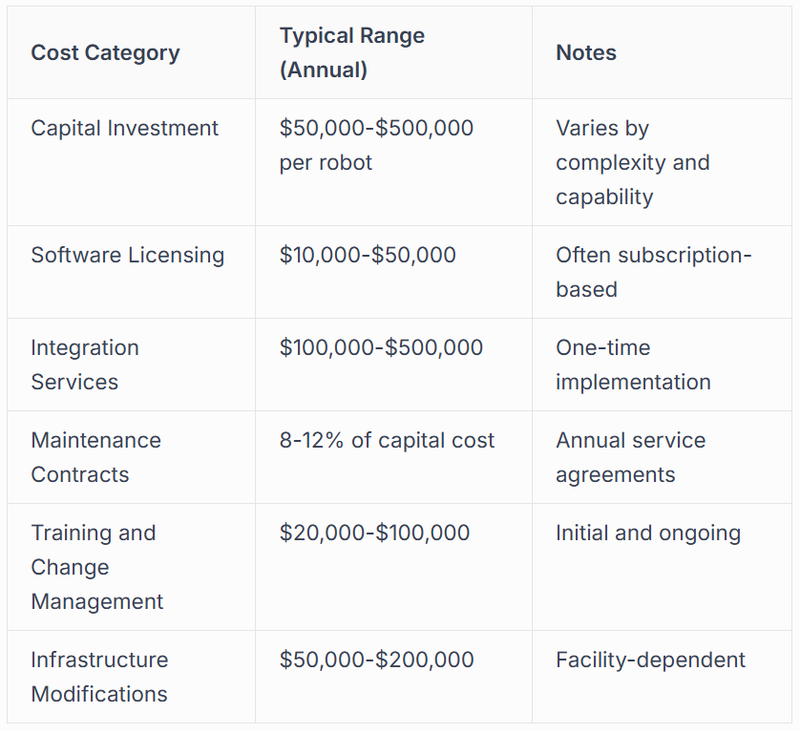
Lease and robot-as-a-service models have emerged as alternatives to outright purchase, reducing upfront capital requirements whilst providing predictable monthly costs. These models particularly suit operations seeking proof-of-concept before full-scale deployment.
Calculating Return on Investment
ROI calculations for warehouse picking robots must balance quantifiable savings against less tangible benefits. Direct savings typically include:
- Labour cost reduction (though redeployment rather than elimination often occurs)
- Overtime elimination
- Improved inventory accuracy reducing write-offs
- Decreased shipping errors and associated costs
- Reduced warehouse space requirements through denser storage
Indirect benefits encompass customer satisfaction improvements, enhanced ability to scale operations, and improved workplace safety. Most implementations achieve payback periods between 18-36 months, with ongoing annual savings of 20-40% of labour costs.
Research demonstrates that validation of warehouse picking strategies through simulation improves implementation outcomes significantly by identifying optimal configurations before physical deployment.
Safety and Workforce Implications
Introducing warehouse picking robots fundamentally alters workplace dynamics, requiring careful attention to safety protocols and workforce development. Successful implementations view automation as augmentation rather than replacement.
Safety Systems and Standards
Modern warehouse picking robots incorporate multiple safety layers ensuring secure human-robot collaboration. These systems prevent collisions, detect human presence, and respond appropriately to unexpected situations.
Essential safety features include:
- LiDAR and vision-based obstacle detection
- Emergency stop systems accessible from multiple points
- Speed reduction in designated collaboration zones
- Acoustic and visual warning systems
- Fail-safe operational modes
- Regular safety audits and certification
Compliance with machine safety standards ensures both regulatory adherence and genuine protection for warehouse personnel working alongside robotic systems.
Workforce Transition and Development
Rather than eliminating jobs, warehouse picking robots typically transform roles. Successful organisations invest substantially in workforce development, creating pathways for picker roles to evolve into:
- Robot fleet supervisors monitoring system performance
- Exception handlers processing items robots cannot pick
- Maintenance technicians servicing robotic equipment
- Process improvement specialists optimising workflows
- Data analysts interpreting operational metrics
This transition requires comprehensive training programmes, transparent communication, and genuine commitment to workforce development. Organisations that neglect human factors often experience implementation resistance that undermines potential benefits.
Selecting the Right Solution for Your Operation
The diverse landscape of warehouse picking robots means no single solution suits all operations. Selection criteria must align with specific operational requirements, growth plans, and existing infrastructure.
Evaluation Framework
A structured evaluation approach ensures comprehensive assessment across critical dimensions:
- Order profile analysis examining SKU variety, order sizes, and velocity patterns
- Product characteristics assessment considering dimensions, weights, and fragility
- Facility layout evaluation identifying constraints and opportunities
- Integration requirements mapping existing systems and data flows
- Scalability planning projecting growth trajectories and expansion needs
- Vendor capability review assessing technical competence and support capabilities
The robotic picking market analysis provides valuable context on technology maturity and adoption trends across different solution categories.
Proof of Concept and Pilot Programmes
Given the complexity and investment magnitude, pilot implementations reduce risk substantially. Effective pilots feature:
- Limited scope focusing on specific operational areas
- Clear success metrics established upfront
- Defined evaluation periods (typically 3-6 months)
- Structured feedback collection from operators
- Detailed performance measurement against baselines
- Executive visibility ensuring organisational commitment
Pilot programmes also reveal integration challenges, training requirements, and process modifications necessary for successful full-scale deployment. The learning gained typically accelerates subsequent rollout phases whilst avoiding costly missteps.
Future Developments and Strategic Considerations
Looking beyond 2026, warehouse picking robots will continue advancing in capability, accessibility, and intelligence. Anticipated developments in autonomous robotics suggest increasingly sophisticated systems capable of handling greater task variety with minimal human intervention.
Emerging Capabilities
The next generation of warehouse picking robots will feature:
- Enhanced manipulation of deformable objects like bags and soft packaging
- Multi-robot coordination for complex picking tasks
- Embedded sustainability features reducing energy consumption
- Augmented reality interfaces for enhanced human-robot interaction
- Predictive intelligence anticipating operational disruptions
These advances will expand viable applications into sectors currently challenged by product characteristics or operational complexity. Food and beverage operations handling irregular packaging, for instance, will increasingly access robotic solutions previously unavailable.
Strategic Planning for Long-Term Success
Organisations maximising warehouse picking robot value approach automation strategically rather than tactically. This perspective encompasses:
Building modular, scalable architectures that accommodate future capability additions without wholesale replacement
Developing internal automation expertise through dedicated centres of excellence and knowledge management
Establishing vendor partnerships focused on long-term collaboration rather than transactional relationships
Creating data-driven optimisation cultures leveraging robotics-generated insights for continuous improvement
Aligning automation roadmaps with broader digital transformation and supply chain strategies
The most successful implementations view warehouse picking robots as foundational infrastructure for competitive advantage rather than isolated productivity improvements. This strategic lens ensures investments deliver sustained value across changing market conditions and evolving customer expectations.
Warehouse picking robots represent more than technological advancement-they constitute a fundamental reimagining of fulfilment operations for the modern supply chain. The systems deliver measurable improvements in productivity, accuracy, and scalability whilst addressing persistent labour challenges facing logistics operations globally. For organisations ready to transform their warehouse operations through intelligent automation, Automate-X combines robotics expertise, system integration capabilities, and industry knowledge to deliver solutions tailored to your specific operational requirements and growth objectives.